

When people start planning trips to Utah’s famous national parks, the conversation usually goes something like this:
“Are you going to Zion National Park?”
“Maybe.”
“What about Bryce Canyon National Park?”
“Definitely.”
“And Capitol Reef National Park?”
Cue confused blinking.
A lot of us adventurous families know all about Zion National Park and Bryce Canyon National Park. They get all the attention, all the Instagram fame, and probably all the souvenir t-shirts. But Capitol Reef? It feels like the middle child of Utah’s national parks. Quiet. Overlooked. Not demanding attention. Turns out, that’s exactly why we loved it.
After spending several days exploring this incredible corner of Southern Utah with our kids, I can confidently say that Capitol Reef National Park will always be one of our favorite trips. It has epic scenery, family-friendly hikes, fascinating history, and fewer crowds. And honestly? That’s a pretty good reason to visit.
NO TIME TO ENJOY THIS ARTICLE NOW? PIN IT OR BOOKMARK IT FOR LATER!
First Stop: The Visitor Center
Like any responsible family visiting a national park, we headed straight to the Visitor Center. It’s loaded with information and rangers who can point you in the direction of a great day trip, plus it’s there that you can get the kiddos set up with the Junior Ranger program. The National Park Service does an amazing job with these programs, and the Junior Ranger Booklet will immediately become the most important document your children have ever received. This booklet suddenly became my kids’ life’s purpose.
The Fruita Campground Amphitheater is another great stop near the visitor center. You can catch ranger-led discussions and astronomy events like evening stargazing!
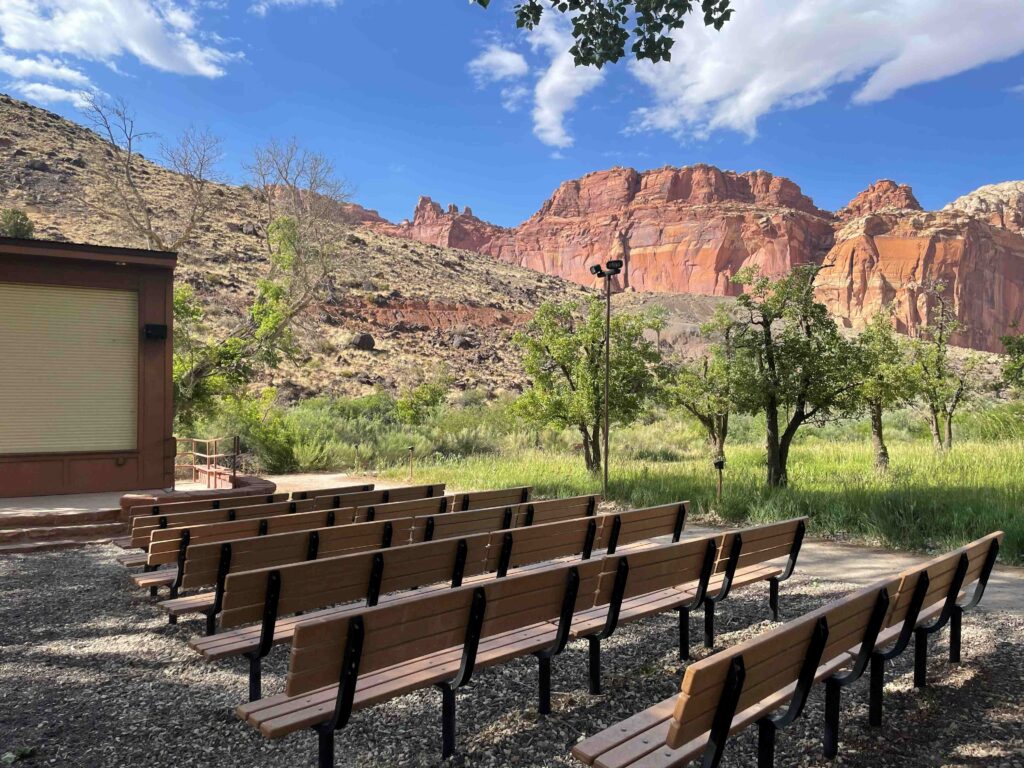
With a backdrop like this, the amphitheater is a must do! Photo by: Laura Kent
Discovering the Waterpocket Fold
One of the most fascinating features of Capitol Reef National Park is the Waterpocket Fold. This massive warp in the Earth’s crust is also where the actual Capitol Reef rock formation is located. If you look just right, you’ll see that the park’s namesake is a rugged area of massive white Navajo Sandstone domes that resemble the U.S. Capitol dome. And, the towering cliffs of Waterpocket Fold act as a natural barrier (reef, get it?) to early travel and wagon trails. Explaining this geology to children can be challenging. I eventually described it as “Earth getting a giant wrinkle.” Surprisingly, that worked, kind of. The kids were mostly just interested in climbing colorful boulders and looking for lizards.
Throughout the park, you can see layers upon layers of rock. Every rock layer tells part of a story that stretches back millions of years.
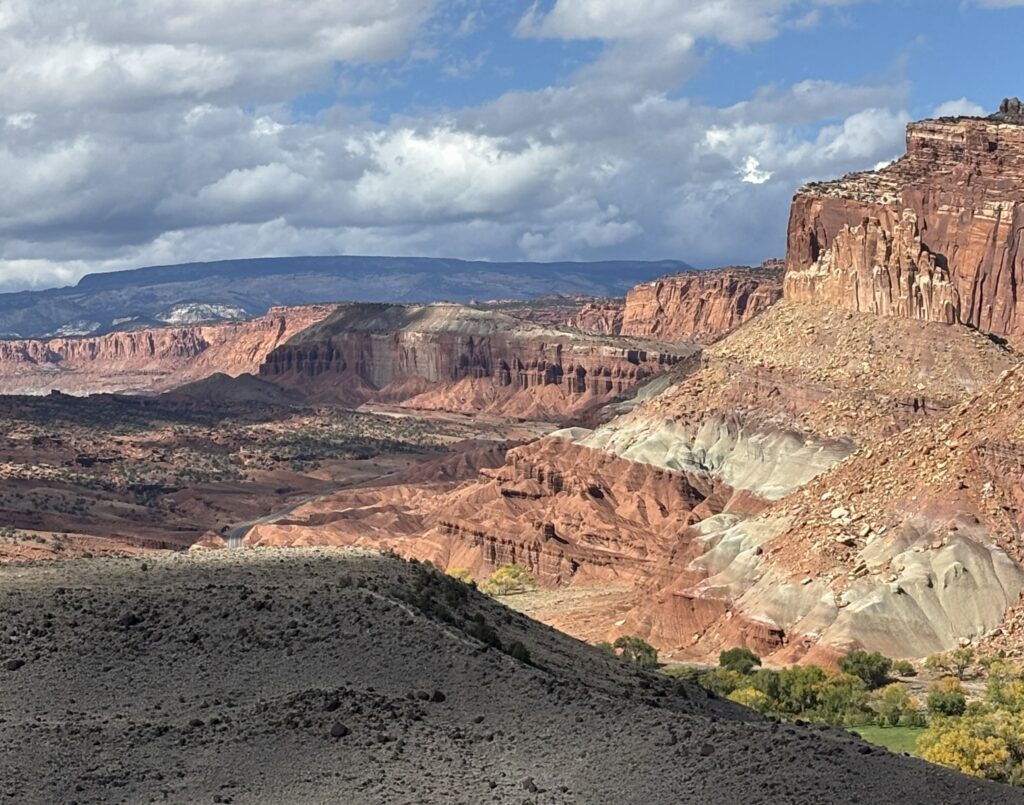
Waterpocket Fold is breathtaking; nature at its best for sure! Photo by: Laura Kent
Fruita Historic District
If there is one place your family absolutely should not miss, it’s the Fruita Historic District. Originally settled by Mormon pioneers and early settlers, Fruita feels like stepping back in time. The Fruita Historic District is definitely the heart of Capitol Reef National Park and includes historic buildings, orchards, and the famous Gifford Homestead. The Gifford House quickly became a highlight of our trip. Actually, that’s not entirely true. The cinnamon rolls that they serve became the highlight.
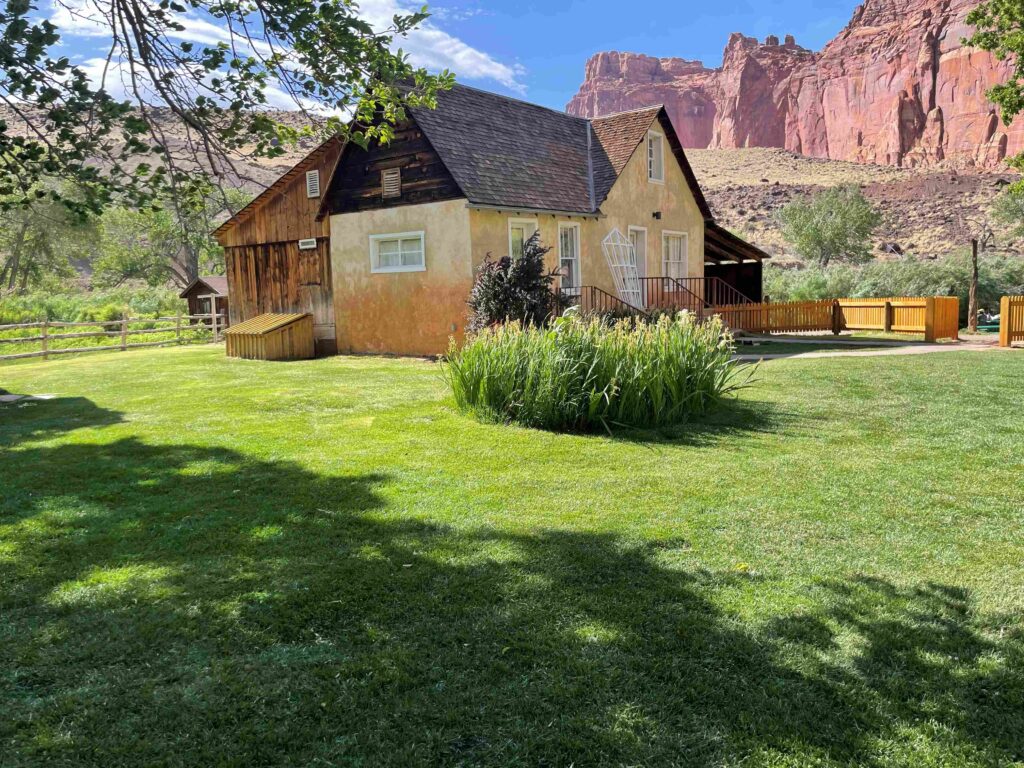
This cute little homestead packs in history, beauty, and culinary genius all in one stop. Photo by: Laura Kent
The Gifford Homestead serves fresh-baked goods, fruit pies, cinnamon rolls, and other treats that should probably be regulated because they are dangerously addictive. We grabbed several snacks and enjoyed them in a nearby picnic area while admiring the views. I regret nothing.
Depending on the season, visitors can also pick ripe fruit from the historic fruit trees. We loved picking apples. You get a basket and what I like to call “the picking pole,” which is not the official name, obviously, but you get the idea, and then you’re off on your own harvesting adventure. Fresh apples harvested right from the orchard are something our kids still talk about. And, any future park visit will absolutely include picking fruit. It’s that fun – because, apparently, apples taste better when you personally pick them while pretending to be pioneers.
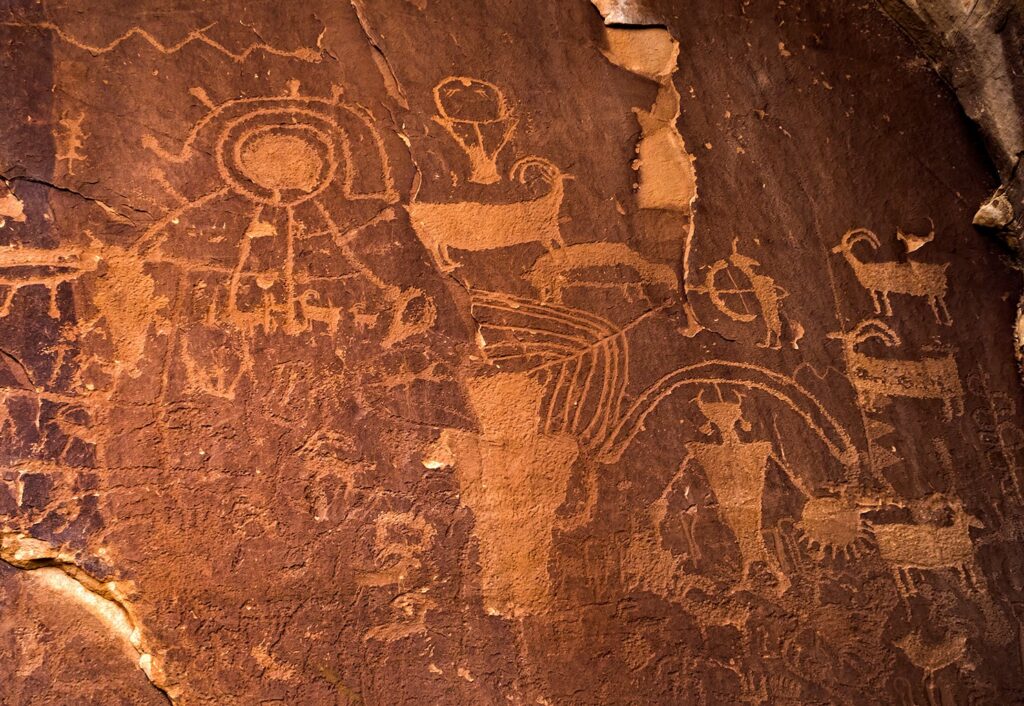
The Petroglyphs are an easy attraction to get to and are such a hit for everyone! Photo by: Laura Kent
The Fremont Petroglyphs
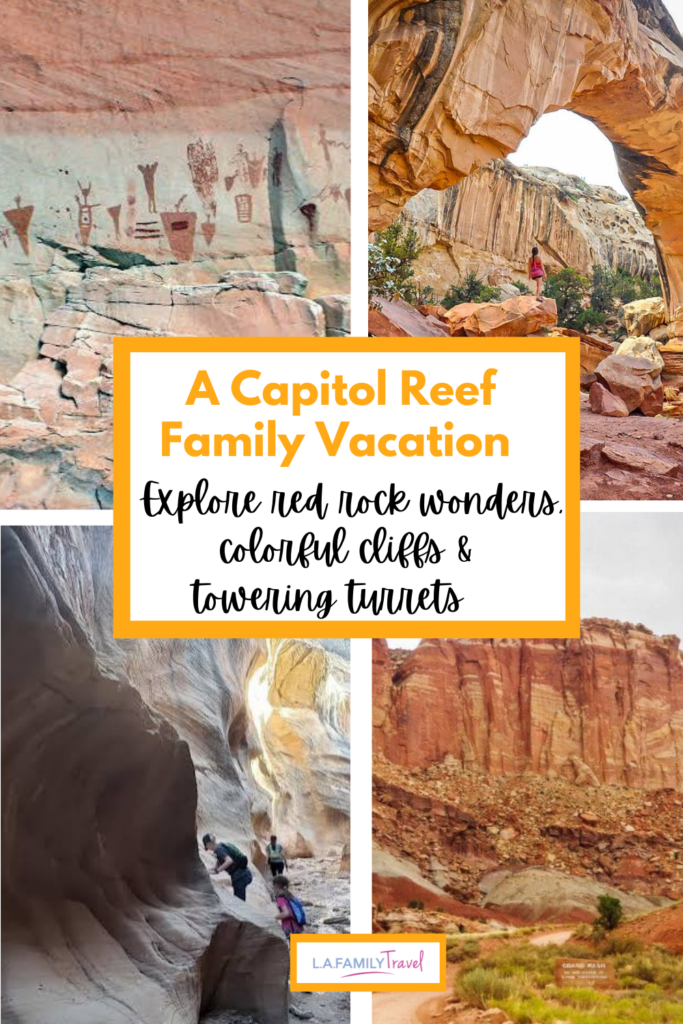
One of our favorite quick stops was the area featuring the Fremont Culture Petroglyphs. The Fremont people lived in this region hundreds of years ago, and seeing their artwork carved into the rock was fascinating. The kids loved coming up with stories about an alien, a horse, and a pot full of steak based on the series of petroglyphs they found, but I’m not sure it was accurate. The best part is that the viewing area is easy to access and requires very little walking. It felt like an instant reward!
For families traveling with young kids, it’s a great opportunity to combine history, culture, and outdoor exploration.
Hiking with Kids in Capitol Reef
We always try to balance scenic drives with actual outdoor activities. Fortunately, Capitol Reef National Park offers plenty of kid-friendly hikes. And, let’s talk about cairns. Cairns are stacked rocks placed to indicate where a trail is and the way to follow it. My kids love to spot cairns, I love to spot cairns, mostly so I know I’m heading in the right direction. Cairns make hiking fun for everyone, I tell you!
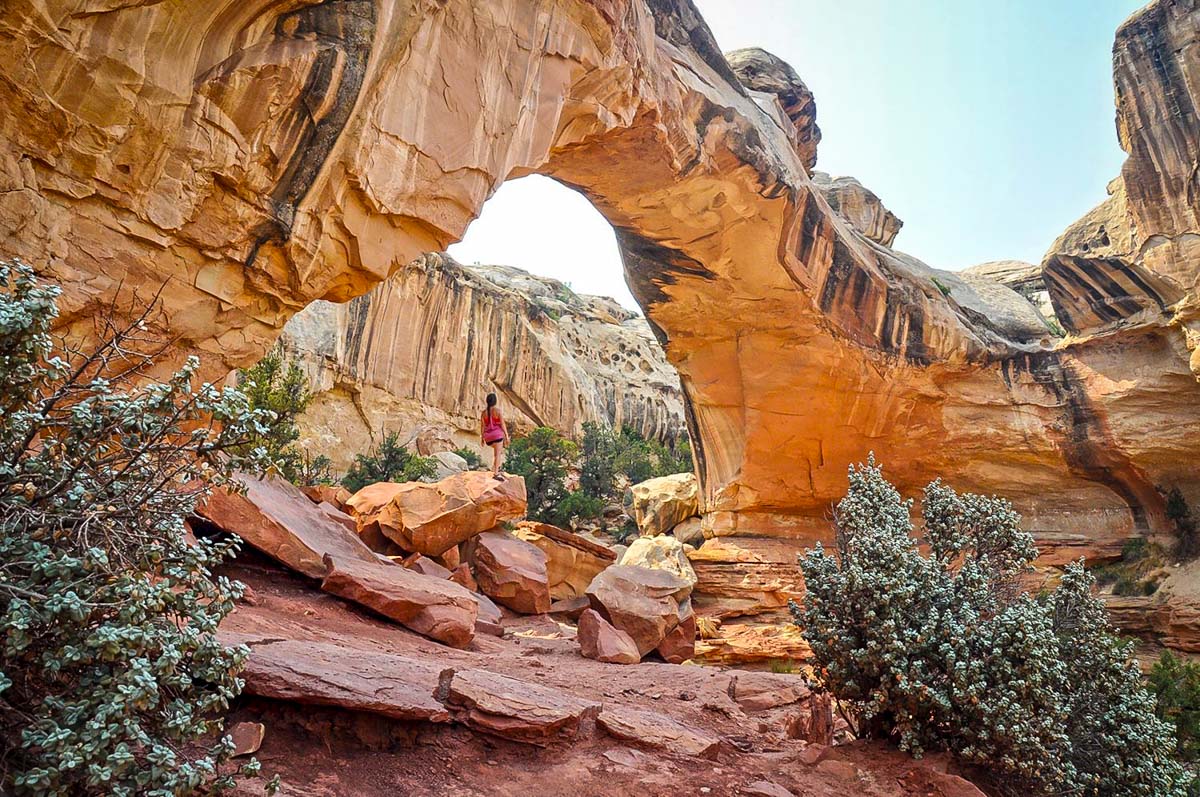
Hickman Bridge Trail
The Hickman Bridge Trail was easily everyone’s favorite hike. It’s also one of the most crowded. This short hike leads to an impressive natural bridge and offers incredible views along the way. Plus, there are loads of wildflowers. The trail has some elevation gain, but it’s manageable for most families. The round-trip distance is reasonable—less than 2 miles—making it a fantastic, easy hike for kids who want an adventure without committing to an all-day trek. The bridge itself is spectacular with its smooth, layered red rock beauty and offers plenty of photo opps.
1.8 miles round trip, ~ 400 ft gain;
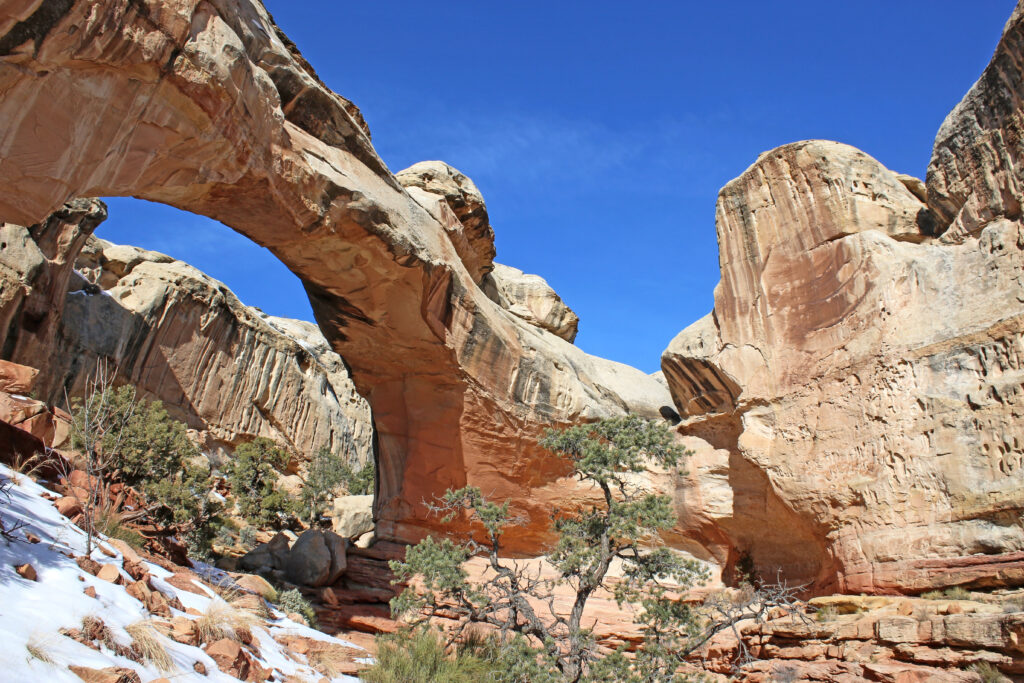
Nature’s lovely bridge. Photo by GreensandBlues
Grand Wash Trail
Another favorite hike was the Grand Wash Trail. Walking between towering canyon walls felt like stepping into another world. Our kids loved exploring the wash, and the wide trail made it easy for everyone to spread out a little. If you’re hiking with younger children, there are several options for turning around whenever you’ve had enough. We chose a good turnaround point based entirely on how much energy our kids had left. Scientific? No. Effective? Absolutely.
4.4 miles out-and-back but flat
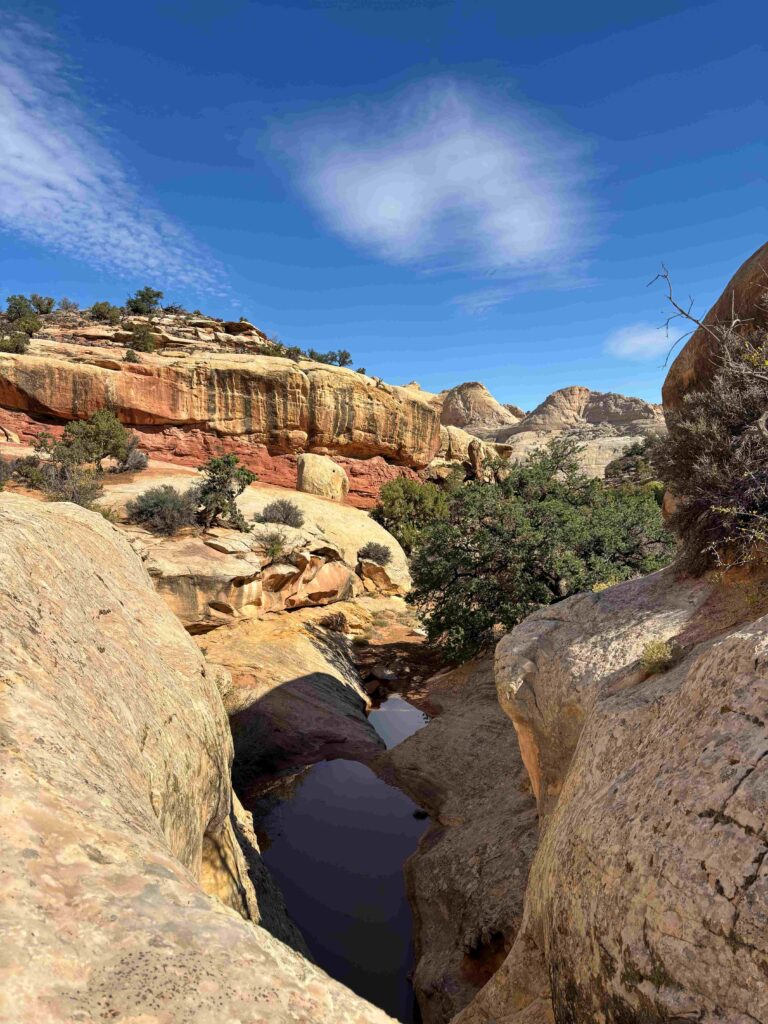
Beautiful creeks and swimming holes are the reward after a day hike! Photo by: Laura Kent
Fremont River Trail
The Fremont River Trail is another excellent family option. This short hike offers beautiful views and a chance to experience a different side of the park. The trail isn’t as famous as some of the most popular hikes, but that’s part of its charm. Fewer crowds, more scenery, plus you’re rewarded for your efforts with a waterfall and swimming hole perfect for a quick and much-needed cool-down. I’ll take that trade every time.
2.0 miles round trip, ~480 ft elevation gain (flat first half, steeper second half)
Capitol Gorge Trail
The Capitol Gorge Trail combines history and scenery in a way kids really enjoy. The easy walk follows a canyon through towering rock formations and eventually leads to the famous Pioneer Register. The Pioneer Register contains names left by early travelers decades ago. Reading these historic inscriptions felt like browsing the world’s oldest guestbook.
2.0 miles round trip to the Pioneer Register, ~100 ft elevation gain
Scenic Drives Win
One of the best things to do in Capitol Reef National Park is simply to take the scenic drive. The park’s paved road winds through the main area of the park, showcasing towering canyon walls, colorful cliffs, and dramatic scenery at every turn. The scenic road is perfect for families because you can experience a lot without committing to a strenuous hike. There are plenty of pullouts and viewpoints, making it easy to stop for Instagram-worthy photos or quick exploration.
For families with younger children, scenic drives are among the easiest ways to experience the park’s beauty while enjoying the A/C. Plus, nobody complains about walking. That’s always a parenting win.
More Great Hikes for Adventurous Families
Families with older children may want to tackle some of the park’s best hikes. The Cassidy Arch Trail offers incredible views and unique scenery. Chimney Rock Trail is another popular option. It is a strenuous hike with steep cliff edges that rewards you with vistas of Waterpocket Fold at the top of 400 ft Chimney Rock. If your family enjoys longer hikes, Sulphur Creek can be an unforgettable adventure featuring water crossings that even the kiddos can handle, a small but glorious waterfall, and a swimming hole to combat the sun. Just be sure to check conditions before heading out.
Cassidy Arch Trail — 3.4 miles round trip, ~670 ft elevation gain
Chimney Rock Trail — 3.6-mile loop, ~590 ft elevation gain
Sulphur Creek — ~5.8 miles one way (point-to-point), ~500 ft descent, requires a car shuttle or hiking back
For experienced hikers, Cathedral Valley offers some of the most remote and spectacular landscapes in the park, with its red, rust-colored turrets and spires shooting into the sky, though reaching it requires driving a dirt road and careful planning, which, of course, I mean, empty your bladder first!
Cathedral Valley — ~58-mile unpaved loop drive, high-clearance vehicle recommended
Goosenecks Overlook
One of the easiest and most rewarding stops in the park is Goosenecks Overlook. This viewpoint offers dramatic views of the canyon below and a gooseneck bend in Sulfur Creek and requires almost no effort to reach. Parents love this. Children love this. Leg muscles love this. Everybody wins. Gooseneck Point and the surrounding viewpoints showcase the immense power of erosion and provide incredible photo opportunities.
0.2 miles round trip, minimal elevation gain
Exploring More
One thing we appreciated about Capitol Reef National Park was the variety of experiences available. You can hike river trails, boardwalk trails, short or long trails, and here’s a fun fact: some of those hikes can be done with or without a llama- because why not! Rock climbing is another popular option, if that’s your thing. Horseback riding is another way to explore the park. You will find all the info you need at the visitor’s center. Point being, this park rewards curiosity. Every turn reveals another overlook, another canyon, or another unexpected view. Even simple drives become adventures.
When You Go
Where to Stay
For accommodations, families have several options. Many visitors choose Fruita Campground, which places you right inside the park. Waking up surrounded by red cliffs sounds pretty amazing.
If camping isn’t your thing, Capitol Reef Resort offers comfortable lodging options. From guest rooms and luxe cabins to covered wagons and colorful teepees, this resort offers unique accommodations, plus amenities like a swimming pool and hot tub, perfect for energetic kids and exhausted parents.
Best Time to Visit
The best time to visit Capitol Reef National Park is generally in spring and fall. Temperatures are more comfortable, hiking conditions are pleasant, and the orchards are often producing fresh fruit. Summer can be hot, especially during the middle of the day, but early mornings and evenings remain beautiful. No matter when you visit, bringing plenty of water is essential; you’re in the desert after all, and Southern Utah takes hydration very seriously.
Don’t Miss: Family Adventure Awaits at these 7 National Parks Near Las Vegas
Things to Know Before You Go
Always check the National Park Service website or other official gov website resources before visiting for current conditions, closures, and updates. Some roads, including Capitol Gorge Road, Grand Wash Road, and routes into Cathedral Valley, may be closed due to weather. Parking is generally easier here than at many national parks, though some trailheads have a small parking lot or limited parking area. Arriving early remains your best strategy. Dogs are allowed in different areas of the park, but must be on a leash; be sure to check trail rules.
Why Capitol Reef
Before visiting Capitol Reef National Park, I assumed it would be a nice stop between bigger destinations. I was wrong. Between the Waterpocket Fold, the stunning canyon walls, the fascinating history of the Fremont people, the orchards, the pie, and the incredible family-friendly hikes, there was far more to do than we expected. We took a ton of scenic drives, tackled short hikes, discovered petroglyphs, completed the Junior Ranger Program, and ate enough cinnamon rolls to feel like the Pillsbury Doughboy. The best part? It never felt crowded. While Zion National Park and Bryce Canyon National Park are absolutely worth visiting, Capitol Reef National Park offers something increasingly rare: space. Space to explore. Space to slow down. And that’s exactly what made this national park experience unforgettable for us.
Getting To Capitol Reef NP from Los Angeles
If you are taking the family on a National Park adventure to Capitol Reef, you likely prefer adventurous travel, so you can drive the 600-ish miles on Interstate 15, and maybe plan a stop in Vegas, and lounge by the pool before you continue on through southern Utah, where you’ll pass red rocks, meandering rivers, and your fair share of cows.
An excellent discount site for rental cars and flights is Booking! We’ve literally saved hundreds of dollars using it.
Capitol Reef National Park with Kids: FAQs
Is Capitol Reef National Park good for kids?
Yes — Capitol Reef is one of the most family-friendly national parks in Utah, with short hikes, easy-access petroglyphs, fruit picking in the Fruita orchards, and a Junior Ranger program. Because it draws far fewer visitors than Zion or Bryce Canyon, kids have room to explore without the crowds.
What are the best easy hikes in Capitol Reef for families?
The best kid-friendly hikes in Capitol Reef are Hickman Bridge (1.8 miles round trip to a natural bridge), Grand Wash (a flat canyon walk you can turn around on at any point), Capitol Gorge (an easy 2-mile walk to the historic Pioneer Register), and the Fremont River Trail, which ends at a waterfall and swimming hole. Goosenecks Overlook is a great bonus stop that requires almost no walking.
How many days do you need at Capitol Reef National Park?
Plan on one to two full days to see the highlights with kids — the Scenic Drive, Fruita Historic District, the petroglyphs, and one or two short hikes. Add a third day if you want to tackle longer hikes like Cassidy Arch or Sulphur Creek, or venture into remote Cathedral Valley.
Is Capitol Reef less crowded than Zion and Bryce Canyon?
Yes, significantly. Capitol Reef receives a fraction of the visitors that Zion and Bryce Canyon do, so trails and viewpoints rarely feel packed — even in summer. Parking is easier, there’s no shuttle system to navigate, and popular stops like Hickman Bridge are busy but manageable.
How much does it cost to visit Capitol Reef National Park?
Much of Capitol Reef is free to visit — the entrance fee (currently $20 per vehicle, valid for 7 days) only applies to the Scenic Drive beyond the Fruita Campground. The America the Beautiful annual pass is also accepted. Always confirm current fees on the official NPS website before your trip.
When can you pick fruit in the Fruita orchards?
Harvest season in the historic Fruita orchards generally runs from June through October, starting with cherries in early summer and ending with apples in the fall. Ripe fruit availability changes week to week, so check with the visitor center or the NPS orchard hotline when you arrive.
How far is Capitol Reef from Los Angeles and Las Vegas?
Capitol Reef is roughly a 600-mile, 9-hour drive from Los Angeles via Interstate 15, and about 330 miles (around 5 hours) from Las Vegas. The nearest town with lodging and restaurants is Torrey, Utah, about 15 minutes from the visitor center.
When is the best time to visit Capitol Reef with kids?
Spring and fall offer the most comfortable temperatures for hiking with kids, and fall lines up with apple harvest in the orchards. Summer works too if you hike in the early morning and save the air-conditioned Scenic Drive for midday heat.
NO TIME TO ENJOY THIS ARTICLE NOW? PIN IT OR BOOKMARK IT FOR LATER!


. I am a master brand storyteller, creative ringleader and kick-a content creator, based in Park City, Utah, where I live with my three incredible kiddos, my guy, and three of the goofiest doodle doggies you’ll ever meet. My specialties include copywriting, content creation, word smithing, editing, proofreading, SEO marketing, brainstorming, and picking brains. I’m also very good at multitasking, single-tasking, and “I’ll just do it myself” tasking. Last, but certainly not least, I specialize in spontaneous bursts of sheer brilliance. I traded life near the Pacific Ocean for mountain town living in Park City, which actually feels like a chill beach town…so, it’s a pretty even trade, except for the snow – obvi!