

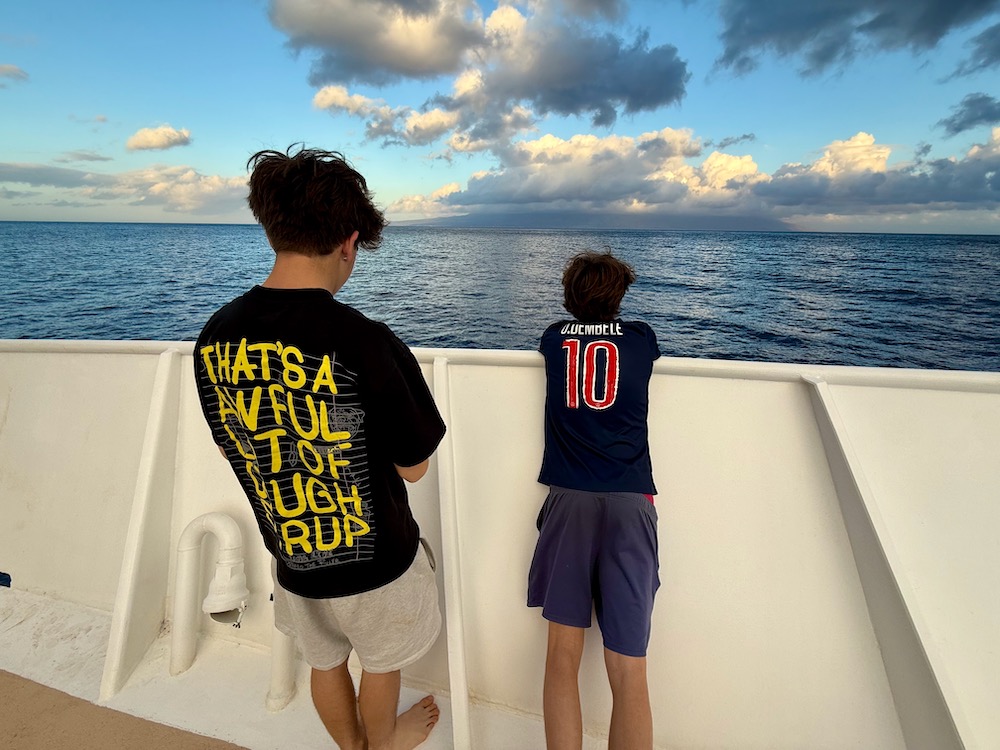
I moved my head forward, careful not to headbutt our Hawaiʻian host as he shared the traditional Hawaiʻian greeting of honi, or breath-giving. His hand wrapped around the back of my neck and slowly guided my forehead to touch his. Our noses briefly connected, and I tried not to jump back from this intimate contact. I took a quick open-mouthed inhale, imagining part of his spirit passing through my lips.
Although our UnCruise Adventures Hawaiʻian Cruise group of 12 had just met Davek Solatorio, the eldest son of the Solatorio ohana, his welcome removed that layer of caution normally reserved when meeting a stranger.
The Solatorio family has inhabited the Hālawa Valley on the Hawaiʻian island of Molokaʻi for 50 generations. They were there when new nations first set foot on the island.
“When they arrived, the Calvinist missionaries wore big-brimmed hats and couldn’t do our traditional greeting. So the natives called them breath stealers, which was haole,” Davek explained.
He repeated this ritual with each of the 12 passengers on this second day of our 7-day Hawaiʻi cruise. Our mission was to explore the lesser-known islands of Hawaiʻi.
When I boarded the night before with my husband, Howard, 15-year-old Knox, and 17-year-old Kaleb, our expedition leader, Dai Mar Tamarck, tall and thin with close-cropped brown hair, warned us that even though the itinerary for the UnCruise Adventures 7 Day Hawaiʻi cruise is the same for every sailing (just in reverse depending on direction), it is never exactly the same. Winds, ocean conditions, weather, and animal sightings divert or change the ship’s course and, therefore, the exact activities.
Here’s what our hosted seven-night small-ship Hawaii cruise with teens was like, and how to decide if an UnCruise is right for your family
NO TIME TO ENJOY THIS ARTICLE NOW? BOOKMARK IT OR PIN IT FOR LATER!
UnCruise Hawaii Quick Facts
| Cruise line | UnCruise Adventures |
|---|---|
| Ship | Safari Explorer, up to 36 guests (12 on our sailing) |
| Itinerary | Hawaiian Seascapes, 7 nights |
| Islands | Molokai, Lanai, Maui, Hawaiʻi Island (Big Island) |
| Season | Dec-May; humpback whales visit in winter |
| Included | All meals and guided daily excursions: hiking, snorkeling, kayaking, paddleboarding, and skiff tours |
| Price | Starts at $8,700 pp but they usually run specials |
| Kid savings | $500 off for kids under 18 |
| Best for | Active families, teens and confident swimmers |
| Not ideal for | Kids who want a pool, kids’ club or lots of downtime |
Rather Watch Than Read? Check Out Our YouTube Video of UnCruise Hawaii!
Day 1 and 2: Molokai Waterfall Hike and Molokai Leper Colony
The day’s journey started with a 40-minute drive from the ship to the Hālawa Valley, located on the east side of Moloka’i, an island with no street lights, at the end of two-lane Highway 450.
The drive itself was an education in Hawaiʻian culture. Our shuttle driver, Gordon, who filled every inch of the driver’s seat with well-worn muscle, has a master’s degree in cultural anthropology and is his family’s historian.
“It takes me 30 minutes to recite our family ancestry,” he said. His lineage ties back to King Kamehameha, the first Hawaiʻian ruler to unite the warring islands. At one point, one of Gordon’s grandfathers, 7 generations back, brought the ruler to Moloka’i for his protection. Gordon is named after the ancient king’s mentor.
After we properly met Davek at the Hālawa Beach Park Pavilion, he escorted us to a grassy field where he shared more about Hawaiʻian history and culture. A red sarong covered his sinewy frame, his black hair pulled back in a bun. He shared that the ancient stories say all life began in the Hālawa Valley. What that might mean is that when Tahitians first arrived in the Hawaiʻian archipelago, they landed in the Hālawa Valley.
At one point, 50,000 people lived here, but tsunamis in 1946 and 1957 wiped out much of the community’s infrastructure and dragged family homes out to sea.
A volunteer (me!) donned a sarong, like the one Davek wore, and he put a ti leaf lei over my neck. He explained that when visitors arrived as guests, they would dress in more formal attire like this and bring a meal wrapped in banana leaf, called ho’okupu, to make up for the time lost while hosting the visitor that would otherwise be spent on hunting and gathering.
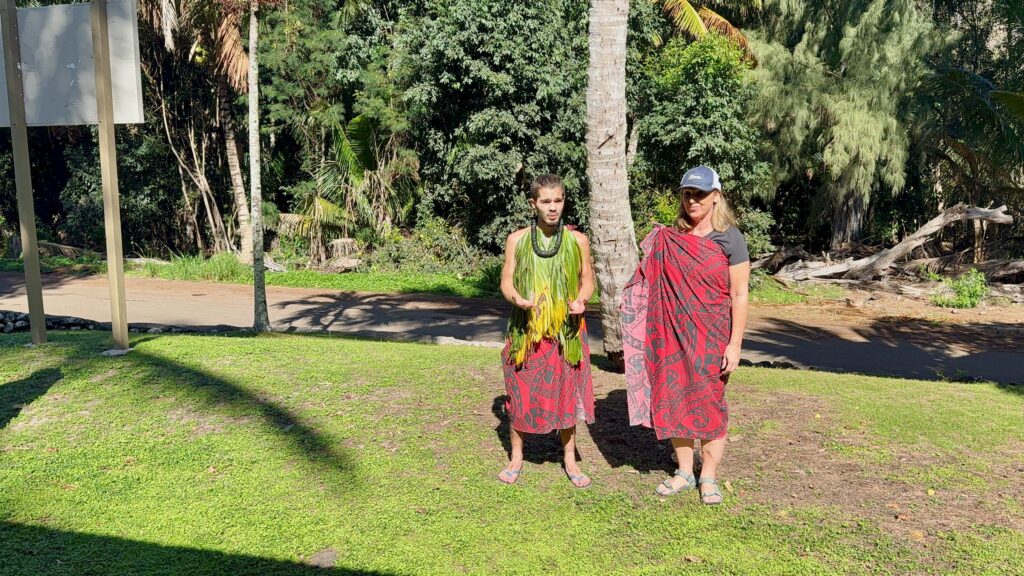
I don’t think it looked as good on me! Photo by Howard Nehdar
We started our walk up a dirt road that led to the Solatorio Hale, or home, and abruptly stopped. Davek took out a conch shell, called a pu, and blew into it. He told us this was how island visitors announced their presence; the bellow asked permission to enter the land. We waited until we heard Davek’s father, Greg, return our greeting with another pu, indicating we were welcome.
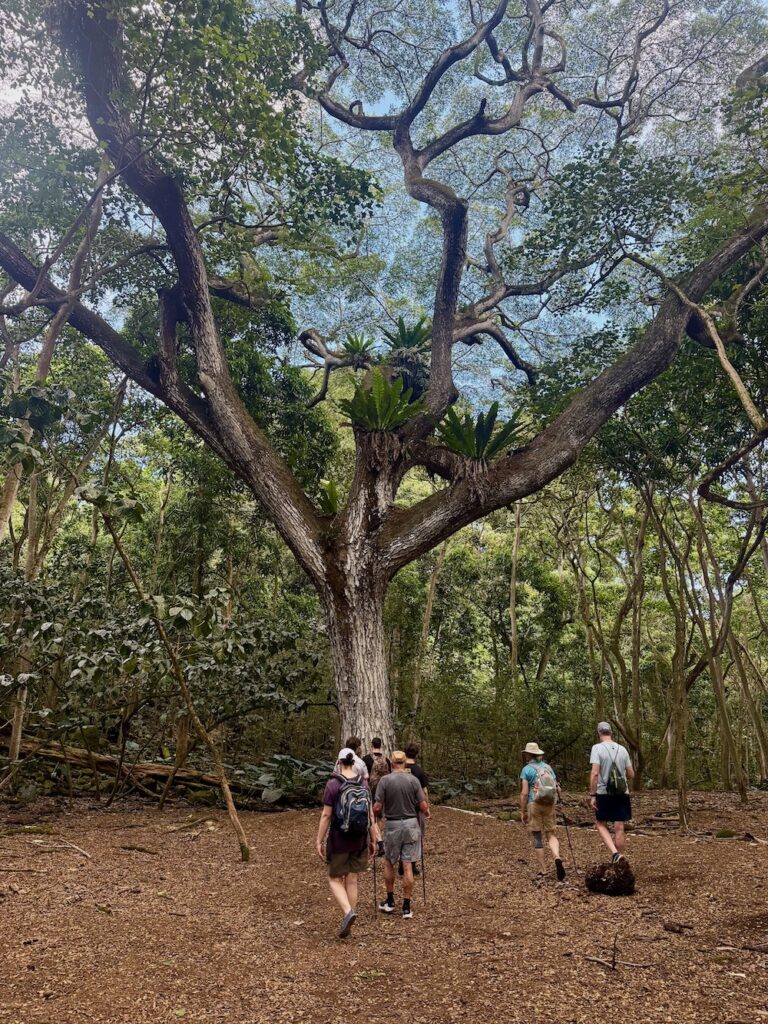
The land with many branches. Photo by Rina Nehdar
Halawa Valley Falls Cultural Hike
Not missing a beat, Davek said, “This is the original shell phone.”
The Solatorio ohana, or family, descendants of one of the original families that settled the island from Tahiti, has taken responsibility for sharing its history by operating the Halawa Valley Falls Cultural Hike.
Guests can choose between a 3.4-mile roundtrip hike to a 250-foot waterfall accessible only through Solatorio land or a cultural presentation in their Hale Ike O Halawa, a modest thatched-roof Polynesian hut filled with photos and ancient treasures. Hikers get a taste of the stories, while those who stay behind to hear more may also get cuddles from semi-domesticated kittens.
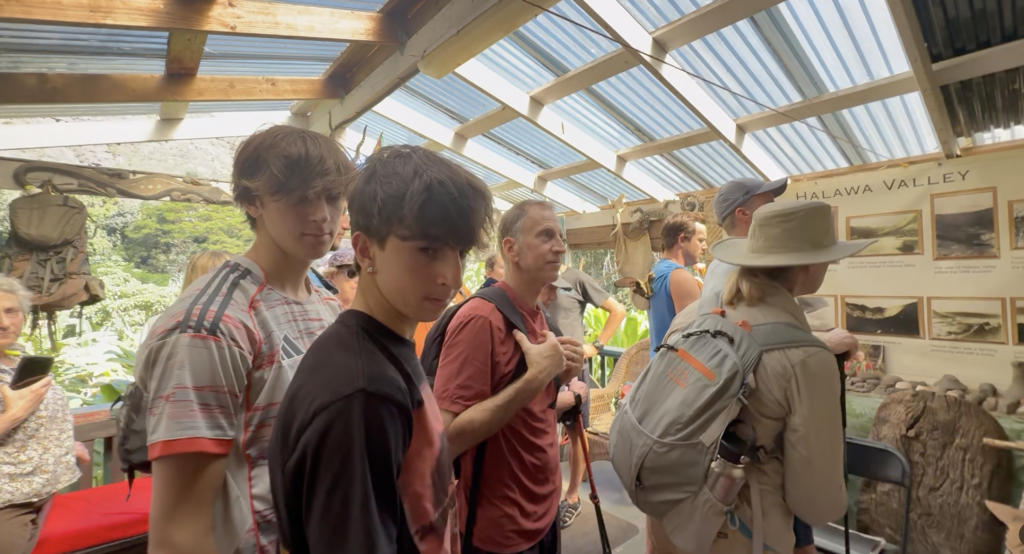
The walk down history. Photo by Rina Nehdar
Our family joined the hiking group. I mean, who could resist a waterfall with a pool large enough for a swim? Though I will say, the hike felt more like five miles, and my legs reminded me of it for the next few days.
I spent most of the time pretending I could keep up with the teens (wear sturdy shoes), captivated by river crossings under jungle canopies while Davek told stories of the taro fields and seven layers of spirituality as we passed the ruins of an ancient open-air temple.
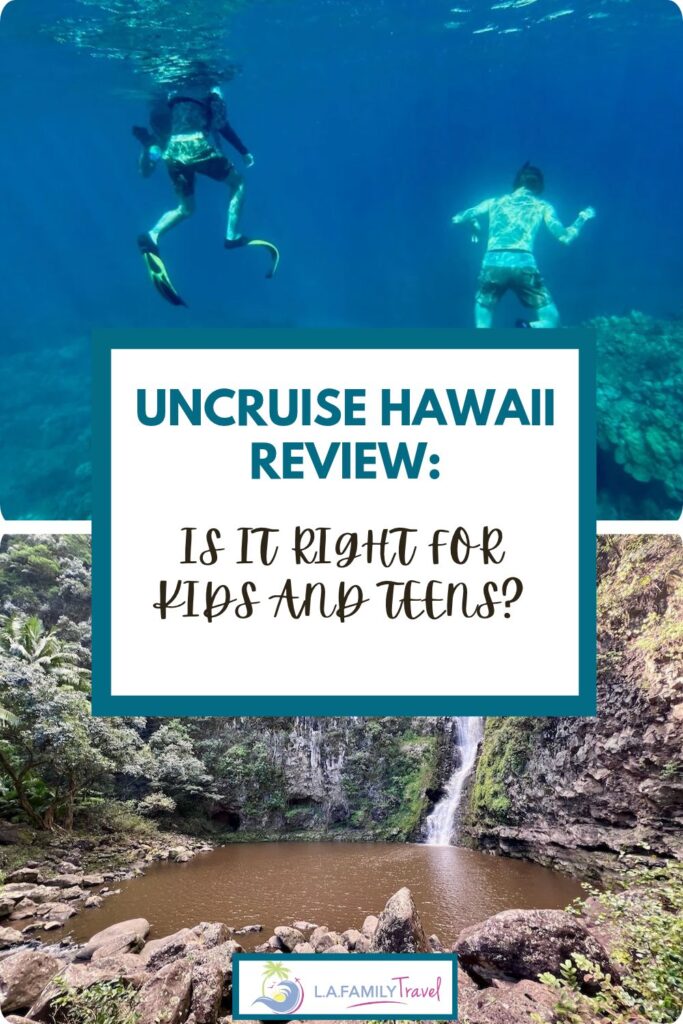
Finally, we reached Mo’oula Falls and spread across the cascade of boulders to admire the 250-foot ribbon of water traveling through rock and tropical foliage to fill the basin. Our UnCruise guides passed out lunches we had pre-ordered the night before. The boys quickly finished eating and started following Davek as he scaled the rock walls to jump into the 30-foot deep pool by the falls. I tried not to picture their bodies slipping off and tumbling against the rock face to their demise. Moms.
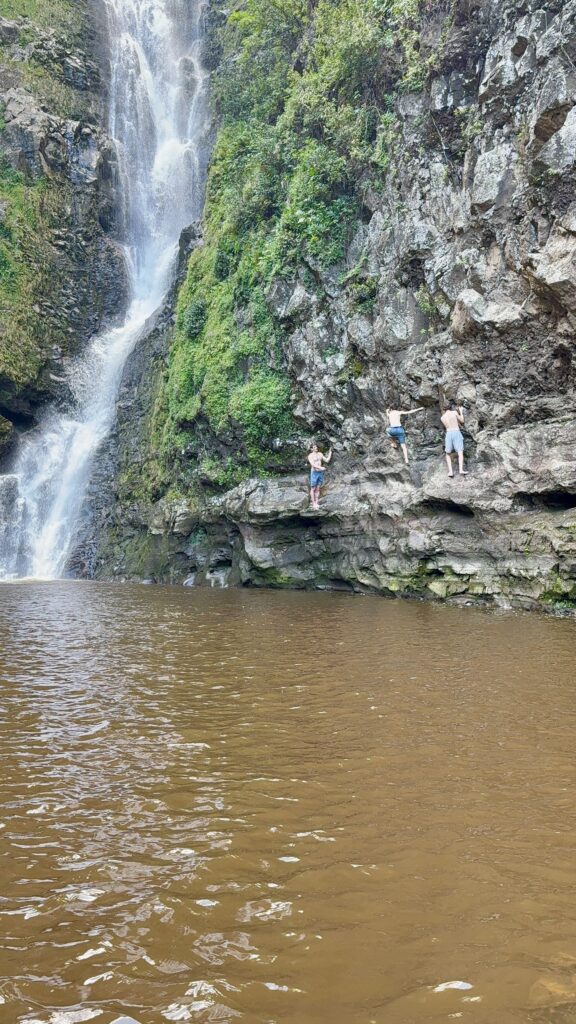
Private adventures. Photo by Rina Nehdar
Molokai Museum & Cultural Center
We didn’t know Moloka’i was once home to a leper colony. After returning to our ship, we washed up and boarded a shuttle to the Moloka’i Museum and Cultural Center.
History of Leprosy in Hawaii
In the late 1800s, leprosy swept through the Hawaiʻian Islands. Introduced by foreign sailors and Chinese laborers, the native’s lack of immunity caused the kingdom to fear the archipelago would become overrun by the incurable and mysterious disease.
On January 6, 1866, the first group of nine men and three women was dropped off on the southeast side of the Moloka’i peninsula in the abandoned village of Kalawao. With the ocean on three sides and the world’s tallest cliffs on the fourth, the area screamed isolation. The afflicted were to live in caves, abandoned shacks, and use the old fields to grow their food.
Initially, these people received no support or medical care. The patients’ illness and depression prevented them from even trying to survive.
It is fear that drives us to act brutally toward each other, but the islands also live by the spirit of Aloha, not a greeting, but a way of relating and caring for each other.
On the evening of our second day cruising with UnCruise Adventures on Molokaʻi, we visited the Moloka’i Museum, where Rick Schonely played ukulele while narrating Auntie Terry’s hula dance. He also shared the history of the Kalaupapa Colony.
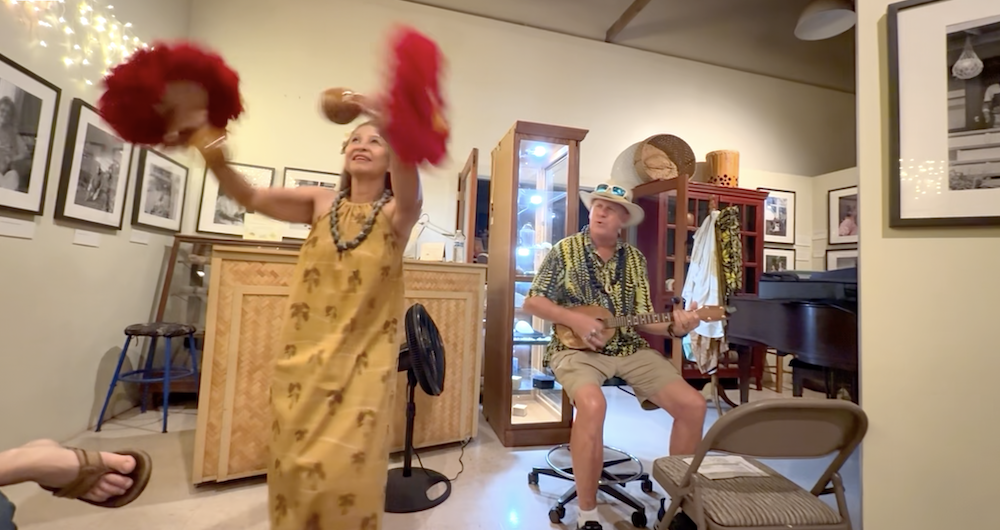
A cheerful pāʻina. A pāʻina is the traditional word for a gathering, meal, or party, while lūʻau originally refers to young taro (kalo) leaves and became the popular name for a large Hawaiian feast. Photo by Rina Nehdar
Many islanders hid family members if they thought they were sick, confining themselves to their homes to care for their sick relatives rather than give them up to the village.
Then in 1873, Father Damien, a Belgian Catholic priest, arrived and began advocating for the settlement. Unfortunately, Father Damien caught the disease in 1884 and died in 1889 before the cure could be found. He loved his congregants and told them that now he was “one of them” after burying 5,000 of them. His advocacy motivated the government to move the colony to the more hospitable west side of the peninsula inside the fishing village of Kalaupapa, building schools, hospitals, and a community.
Photos of residents hung on walls surrounding our dinner tables, and each contained a brief description of their lives. The most surprising thing was how normal their lives looked.
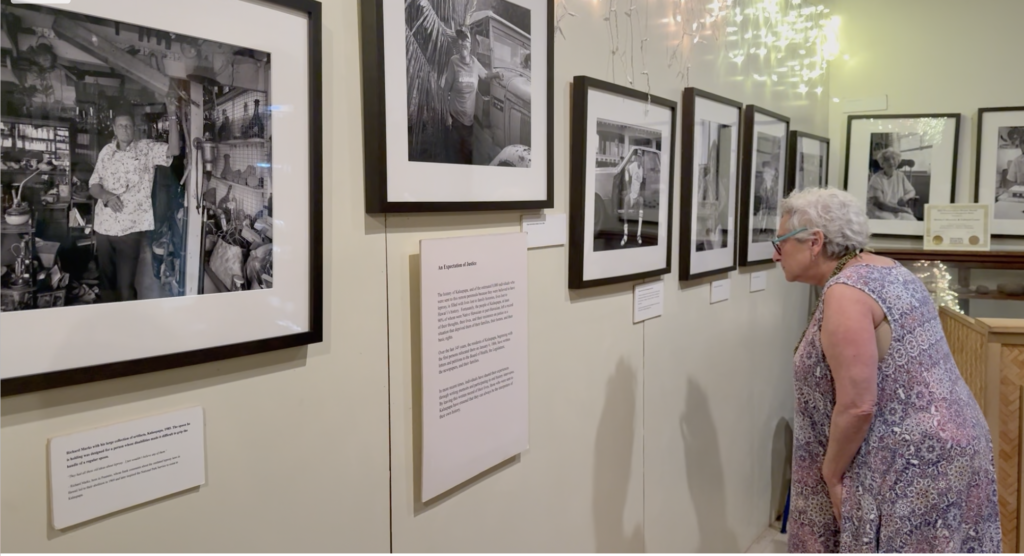
Memories of another time. Photo by Rina Nehdar
The colony closed in 1969, but a few residents chose to stay, even though their disease had been cured. Even harsh confinement couldn’t keep out the spirit of aloha.
How A Hawaiian Cruise with UnCruise Adventures Is Different From A Regular Hawaiian Trip
The Hawaiʻian archipelago consists of 137 islands. Eight are major, but only seven are inhabited.
I’d been to Hawaiʻi several times since I was a teenager. I’d visited Maui three times; my stepson moved to Kauai a few years ago, so we’ve gone there a few times too. I visited Oahu and the Disney Aulani Resort, where I began what I thought was a deep dive into Hawaiʻi history. This culminated (I thought) at FestPac, a gathering of all the Pacific Island nations held every four years that strives to exchange ideas and honor their heritage. But I had never heard the stories and rituals that I had already learned by day two of our Hawaiʻian cruise. The UnCruise program gives passengers a “Choose Your Own Adventure” itinerary that varies with weather conditions, animal sightings, and opportunities to mine for cultural and environmental gems.
Not sure which island to visit on your own? Read Hawaii with kids: Kauai vs. Oahu vs. Maui.
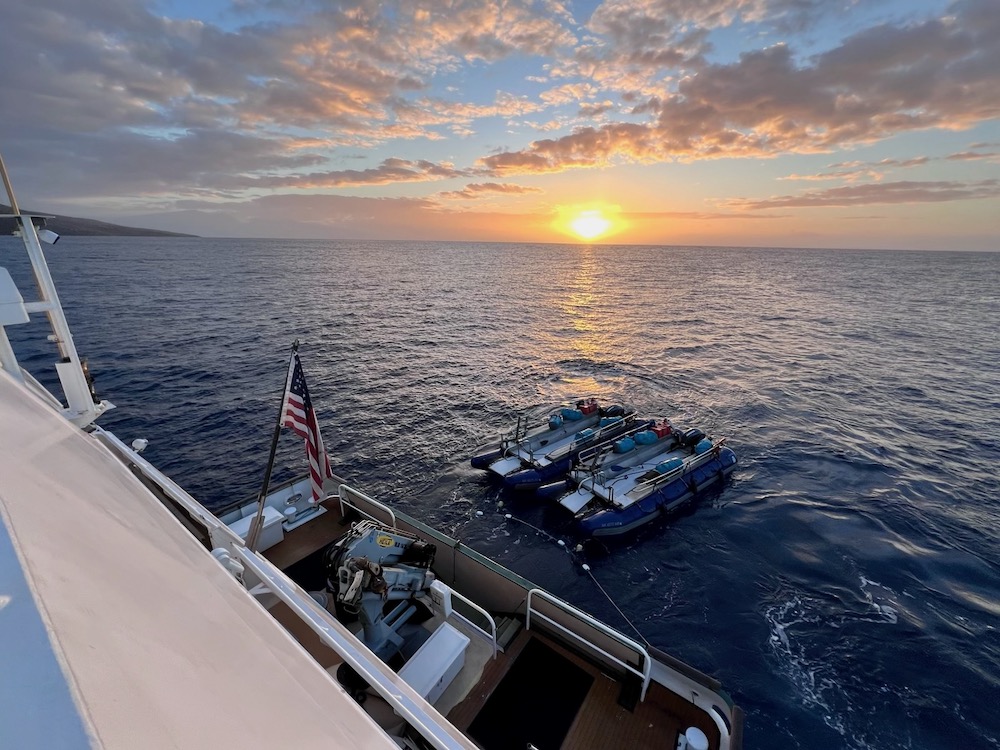
The spirit lives. Photo by Rina Nehdar
Small Ship Intimacy
UnCruise Adventures ships are small. They’re the only small ship cruise company to sail the Hawaiʻian Islands. Our boat, called the Safari Explorer, accommodates up to 36 passengers. On our journey, our family of four was among 12 passengers. So everyone had no choice but to interact and learn about one another. I never felt like just a customer, as we got to know the crew and their occasionally quirky personalities throughout our week. The one thing everyone had in common was the desire to satisfy their curiosity about the place we were exploring and a sense of adventure.
Dai Mar shared with us that he had asked an active, older older couple what their secret was after observing their vitality during a previous sailing. They responded by advising the younger generations to “Never stop moving.” He told us the people who are drawn to an UnCruise were those who loved to live active lives.
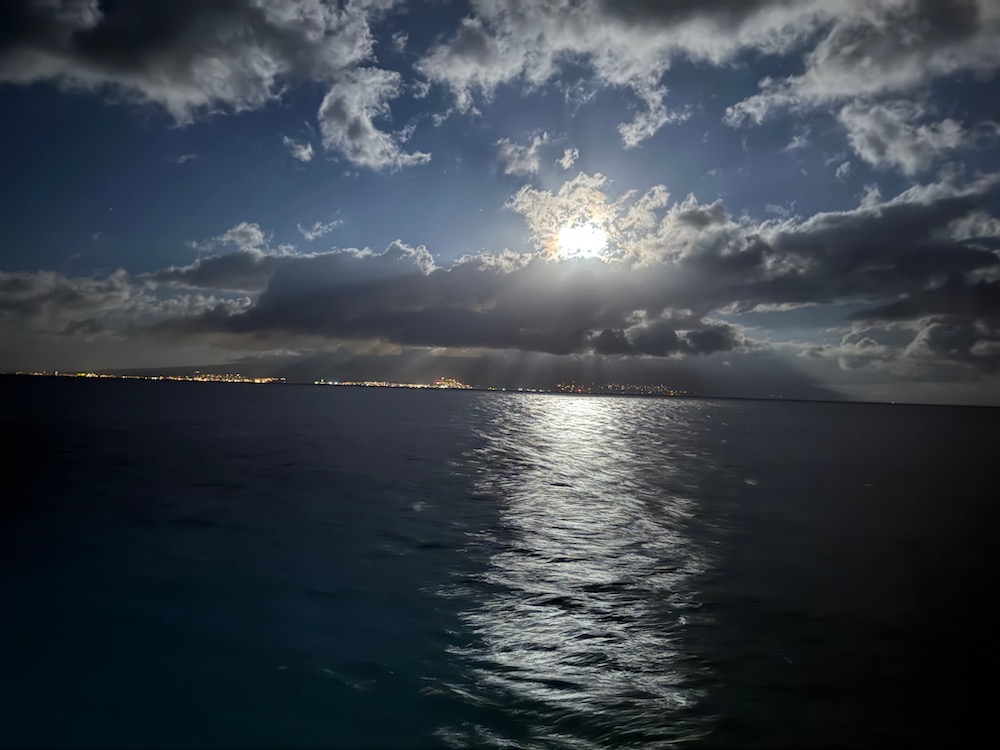
Quiet moments among the adventure. Photo by Rina Nehdar
Food On An UnCruise
With so few people onboard, the ship has one dining room where everyone eats at the same time. There are about 10 tables of various sizes set in a cozy room with windows on both sides showing off the islands as we pass them and sea life when it appears to say hi. Friends and family rotate tables with other passengers for fresh conversations and experiences.
A bar sits on one side, with cozy cushions against the wall on the other. The space doubles as a presentation hall when experts come onboard, and for the post-dinner talks with the captain.
Only breakfast has a time range and a buffet. The other meals have set times for everyone and are ordered at the end of dinner while guests enjoy dessert or a nightcap. Lunches depend on the timeframe of the chosen activity; sometimes it’s a bagged meal, and other times it’s served onboard after the morning activity.
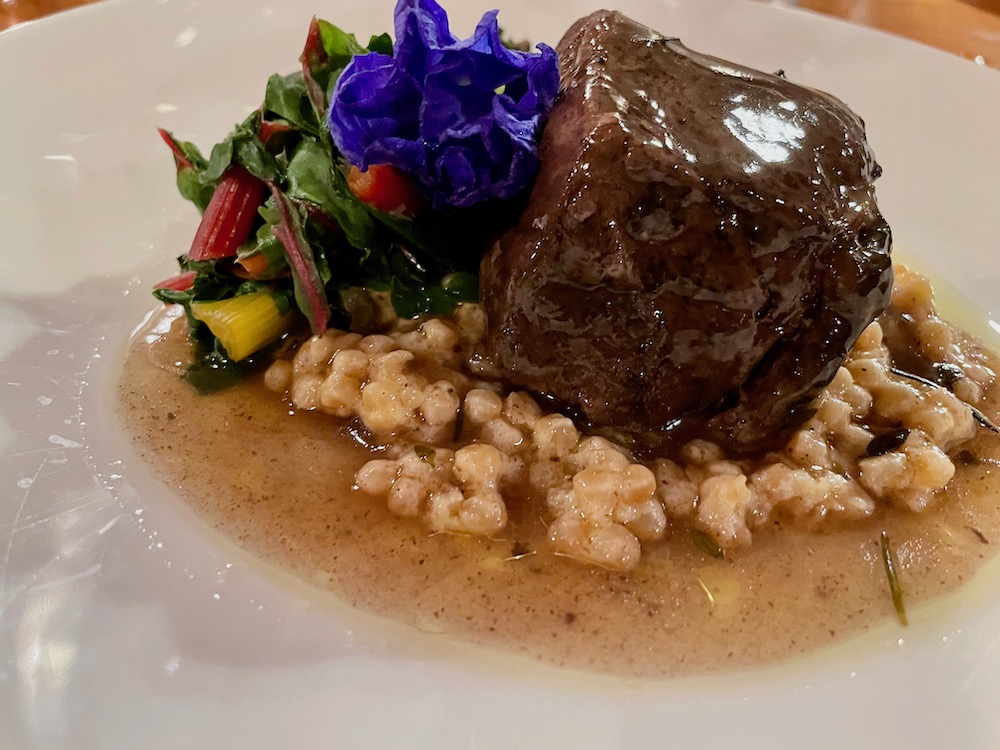
Every morsel delectable. Photo by Rina Nehdar
Daily Excursions: What’s Included
Every day brings a choice of two included excursions. One, right after breakfast, and the other after lunch, unless the morning activity takes us past lunch, like the Halawa Valley hike. Passengers sign up for their activity choice after dinner. Sign-up sheets hang in a hallway by the dining room offering options for various effort levels.
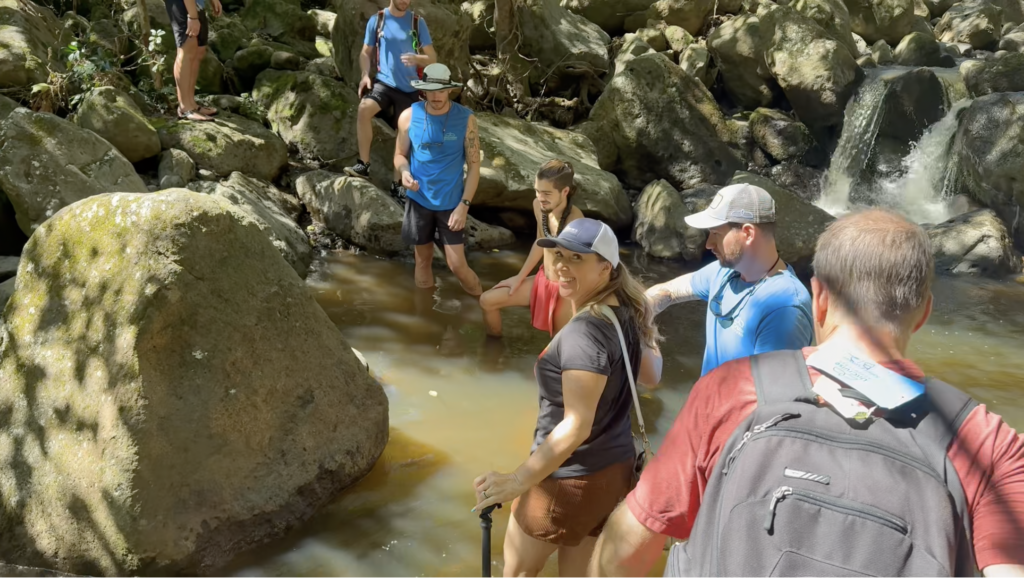
Always up for an adventure! Photo by Knox Nehdar
Evening Talks Even Teens Loved
My boys aren’t particularly the sit around and learn type. That’s not a criticism. They’re more into movement than sitting still and listening (hence the active UnCruise vacation and Segway tours we usually take). So, I was surprised to see them engaged in the talks with Captain Tiffany and Expedition Guide Shelby.
Every night, we’d dim the dining room lights after dinner and sit around the couch area or tables to watch a PowerPoint presentation about our next day’s adventures. I would sneak peeks at my boys, their features lit up by the low lights, and feel a smidge of pride watching them take it in.
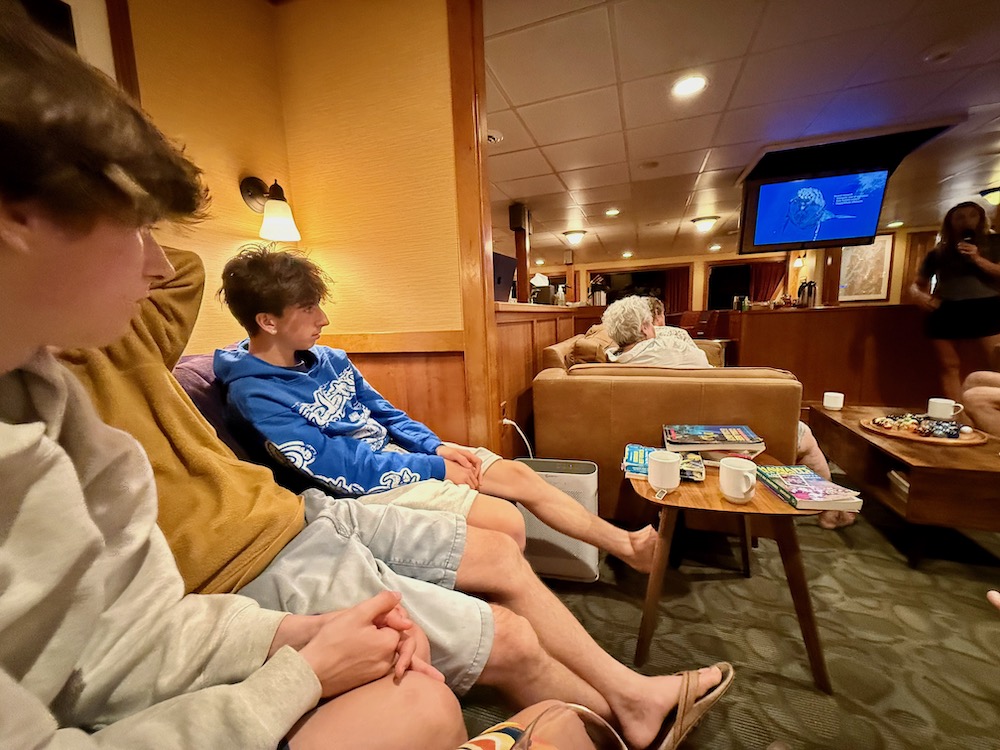
All ears. Photo by Rina Nehdar
Day 3: Molokai’s Sea Cliffs and Snorkeling Shipwreck Beach, Lanai
Kalaupapa Cliffs
The weather forced us to change routes on our way to Lānaʻi, but the entire crew couldn’t have been more excited. Typically, the tides and atmosphere routed the ship to the south side of Moloka’i, sailing to Lānaʻi, but the same circumstances allowed us to glide past the north side instead.
What the crew knew—and we didn’t—was that the highest sea cliffs in the world awaited us on the north side of Moloka’i.
When our ship arrived at the cliffs, Expedition Guide Shelby called everyone over the loudspeaker to the deck to see this rare spectacle. She told those of us who gathered in the weak morning sun that this was the first sailing of the season when the ship could glide past the Kalaupapa Cliffs.
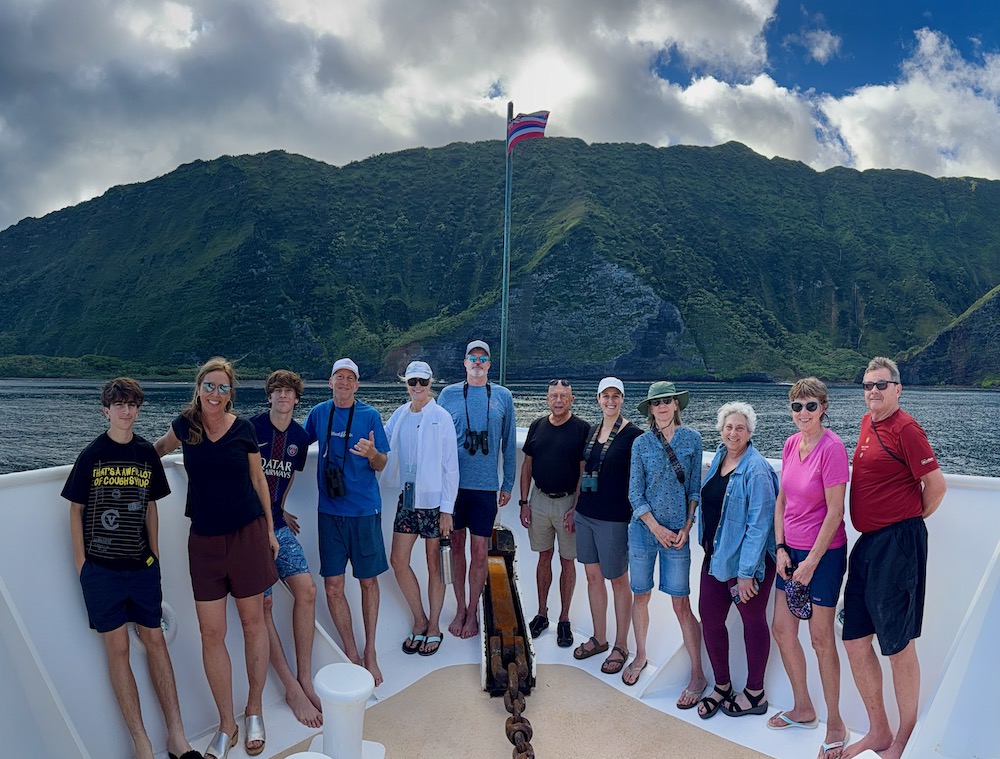
Island groupies.
We stopped talking as the stark, almost 4,000-foot-high cliffs came into view. The rock showed signs of distress across its raw black face. Claw marks scraped across its lower half, scars left after a third of the volcanic island plummeted into the ocean millions of years ago. A waterfall came into view between two verdant peaks. The Oloʻupena Falls, almost 3,000 feet high, is the tallest in the United States and the fourth in the world. Cameras clicked, and phones faced the spiritual ensemble. Only ship Steward Ben cracked jokes during the reverent moment.
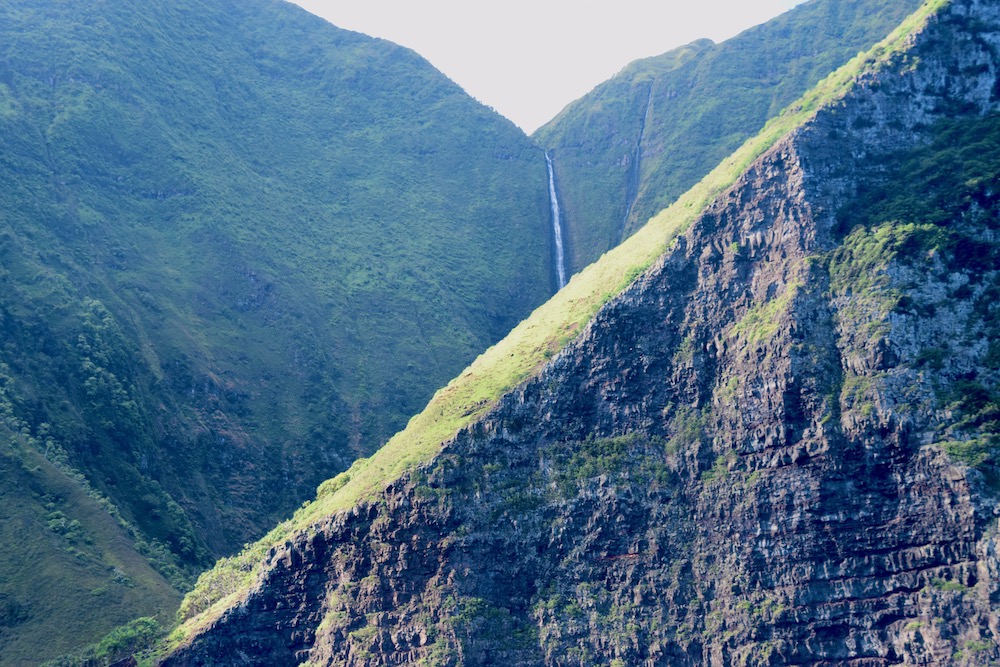
We needed a moment. Except Ben. Photo by Rina Nehdar
Shipwreck Beach
With the ocean and air tumbling this way and that, none of the other cruise or helicopter operators attempted to navigate the Hawaiʻian ocean. This is when our crew decided a snorkel was a good idea.
Those willing to participate threw on their bathing suits, grabbed their assigned dry bags filled with their snorkeling gear, and boarded the dinghy. We drove across the water to a ghost ship visible from Shipwreck Beach (aka Kaiolohia) on the north shore of Lāna’i. Most people only see the abandoned Navy ship from the shore, but we got to see it from the water.
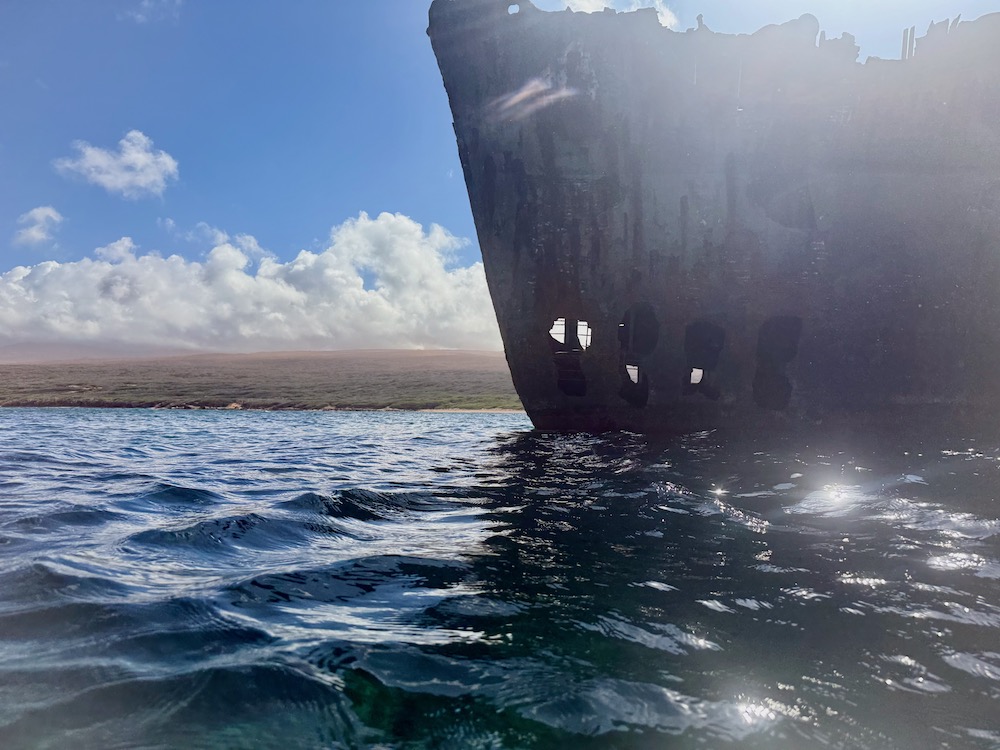
Just a shell of its former self. Photo by Rina Nehdar
History of the Ship
There are a dozen or so ships that fell victim to strong trade winds along the AuʻAu Channel and the vicious shallow reef, but most are beneath the water. Two ships, six miles apart off Shipwreck Beach, still float. The one we saw, YOGN-42, is a former ferro-cement fuel barge. The cement is why it’s still standing after seventy-plus years of salt and storms. The other, YO-21, floats on the Kalohi Channel, a six-mile shoreline walk from YOGN-42. YO-21 was a Navy yard oiler that was actually present at Pearl Harbor on December 7, 1941.
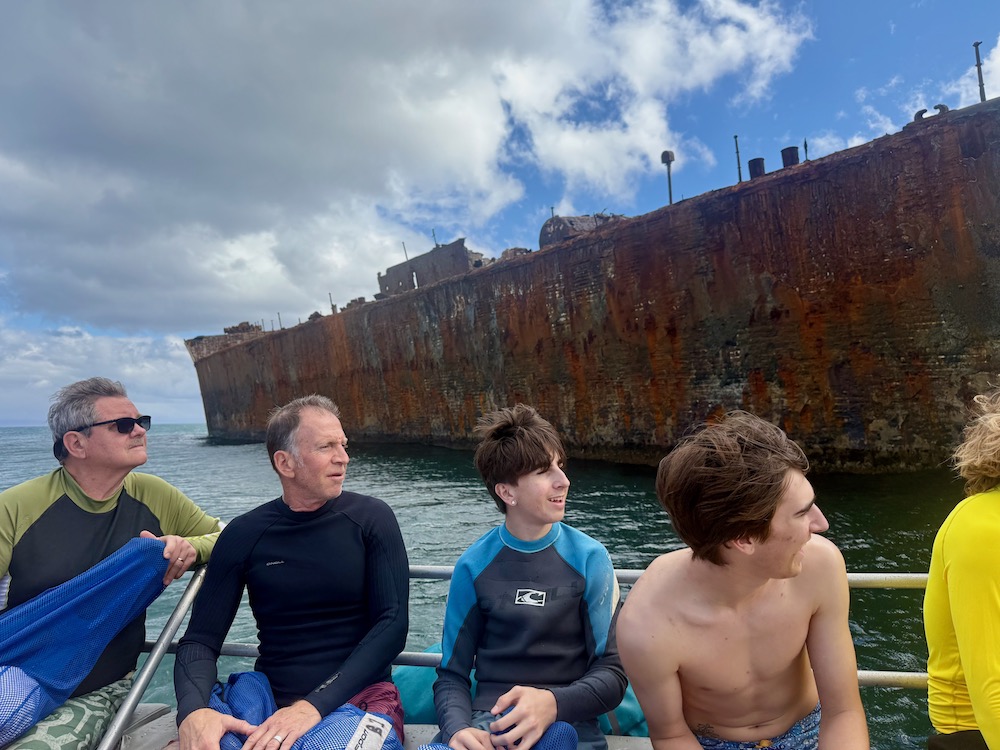
Our first snorkel. Photo by Rina Nehdar
The Snorkel
The water felt chillier than what I remembered in Hawai’i, and the current lived up to its reputation. I noticed more fish on the beachside of the barge. Regardless, it was our first snorkel of the trip, and we all made it around the rusting hull, chasing schools of fish and challenging ourselves with the depth of our free dives.
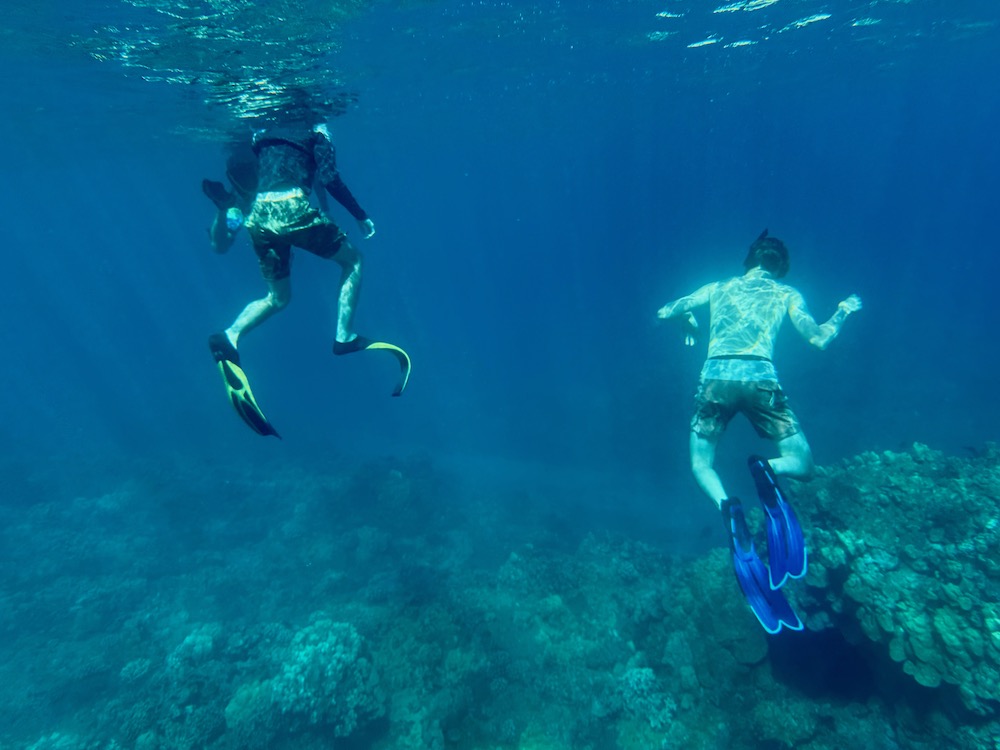
Sometimes they get deep. Photo by Rina Nehdar
When we reboarded the Safari Explorer, Mia, our Steward and Bartender, welcomed us back with cocktails and snacks. If only every return could be this good.
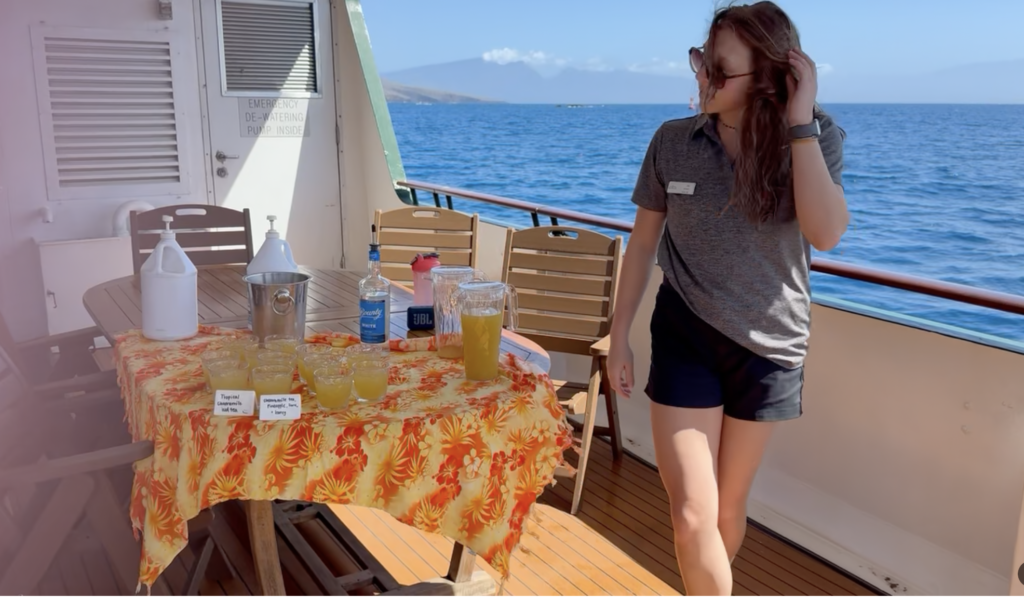
A tasty return! Photo by Rina Nehdar
Day 4: Lanai City Bike Tour, Hulopoʻe Bay Snorkel and Whale Watching
After the humorous presentation of our lunch and dinner options by Chef Rachel and Pastry Chef Brittany, we piled into the dinghies to arrive at Manele Harbor, the port where visitors from Maui arrive when they visit Lānaʻi.
We broke off into three groups at the Lāna’i Adventure Park. One group went to the Lāna’i Cat Sanctuary. Another headed out to do a challenging mountain e-bike. The last group set out for a ride into town. The boys and the rest of the passengers were in the first two groups. I was in the third. I couldn’t believe more people weren’t interested in exploring the town for the only day we’d be in Lānaʻi, yet off they went to conquer nature and cuddle cats. Luckily, I had Expedition Guide Matt and Lāna’i Adventure Park tour guide Blaze with me.
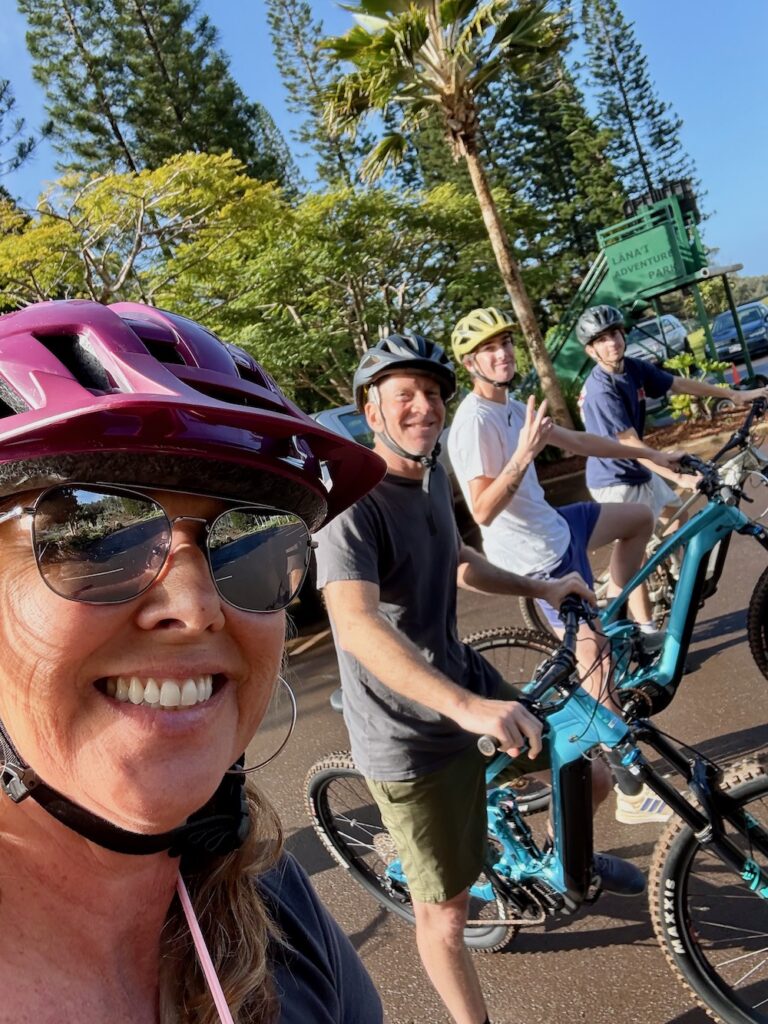
Before the adventure. Photo by Rina Nehdar
Unlike the other islands, which are layered with resorts, Lāna’i only has two Four Seasons resorts and a historic boutique hotel. There are no traffic lights on the island. Downtown is four square blocks around Dole Park.
History of Lanai
James Dole bought 98% of Lāna’i in 1922 to grow pineapples. He built Lāna’i City to accommodate his workers. At one point, Lānaʻi sold 75% of all pineapples in the world. When the market shifted, he sold the island and company to Castle & Cooke which self-made business mogul David Murdock then purchased.
It was Murdock who turned the Dole company around and built the two resorts. When tourism didn’t take off the way he’d hoped, and his proposed windmill farm died in bureaucratic red tape, Murdock sold his entire interest in 2012 to billionaire Oracle founder Larry Ellison.
Ellison made many improvements to public infrastructure that had suffered under Murdock’s financial strain. He renovated the community pool into a resort-style space, upgraded the movie theater, and reopened the community center. He also spruced up Dole Park, which became the central hub of town.
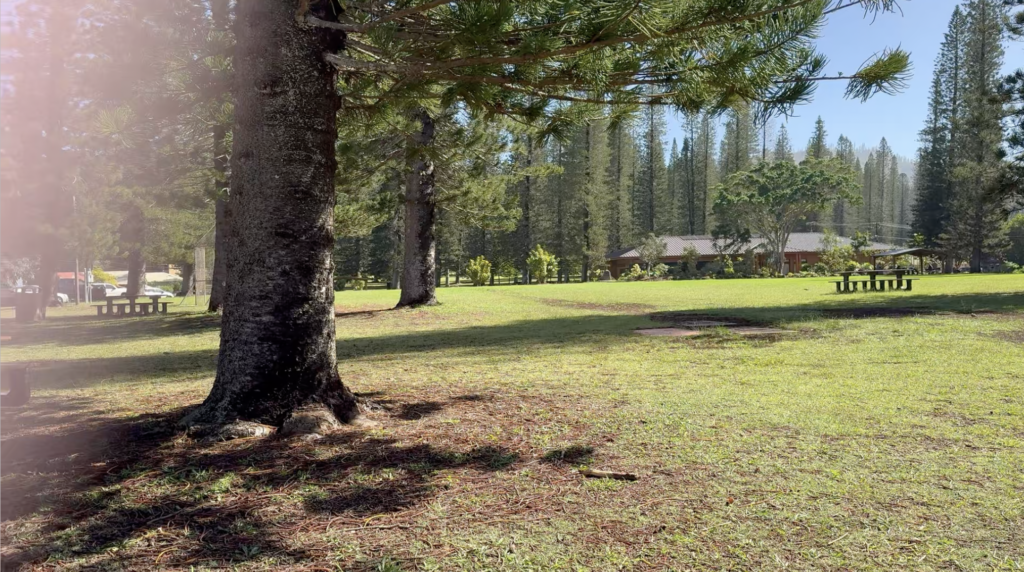
Green space. Photo by Rina Nehdar
Town Bike Ride
The guides rode in front of and behind me as we left our gathering spot and rode toward town. On the way, we stopped by the ruins of Kōʻele Protestant Church and the Kōʻele Grammar School adjacent to the Cavendish Golf Course and nearly ensconced by a canopy of trees.
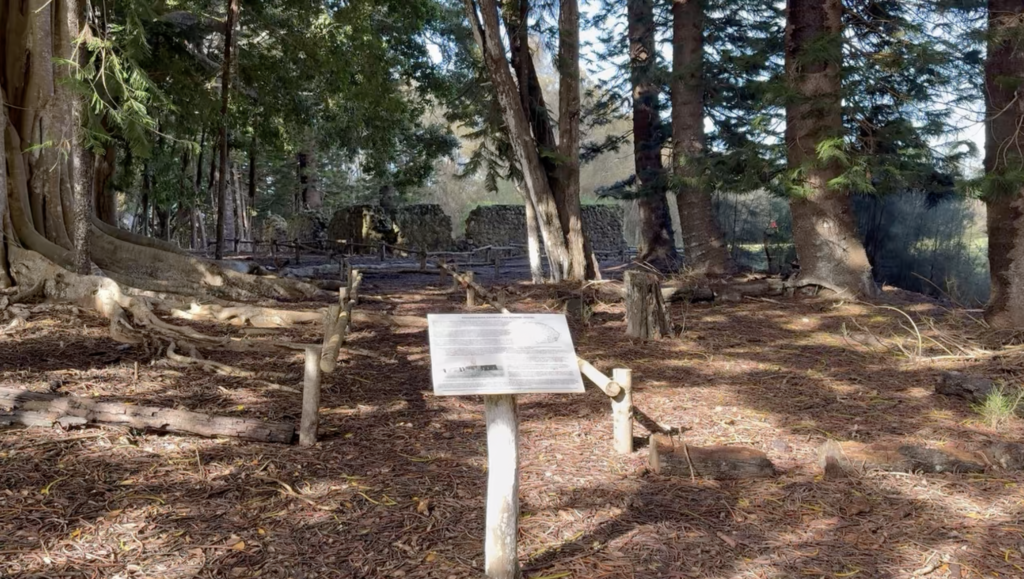
The past is all around. Photo by Rina Nehdar
We rode past the recently renovated community center and pool and the Tesla housing project. Officially named Hōkūao, it’s a planned community designed to ease the housing crunch for locals by offering low-income rentals as well as fair-market ones. The cool thing about it is it’s an off-the-grid community, constructed with Tesla solar roof shingles and includes Powerwall batteries and environmentally supportive furniture and appliances.
Blaze said Lāna’i is one of the world’s premier big-game hunting locations with sheep and deer as the prize. I was sad when I heard this, but because of the lack of natural predators, hunters help keep the populations from overrunning the island. Joe Rogan, a podcaster I love, uses bows here.
We parked the bikes by the Lānaʻi Culture and Heritage Center and the guides let me walk the four blocks of downtown Lānaʻi that surround Dole Park. Around the park are two restaurants, two markets, two art galleries, two clothing/gift shops, two churches, and a bank.
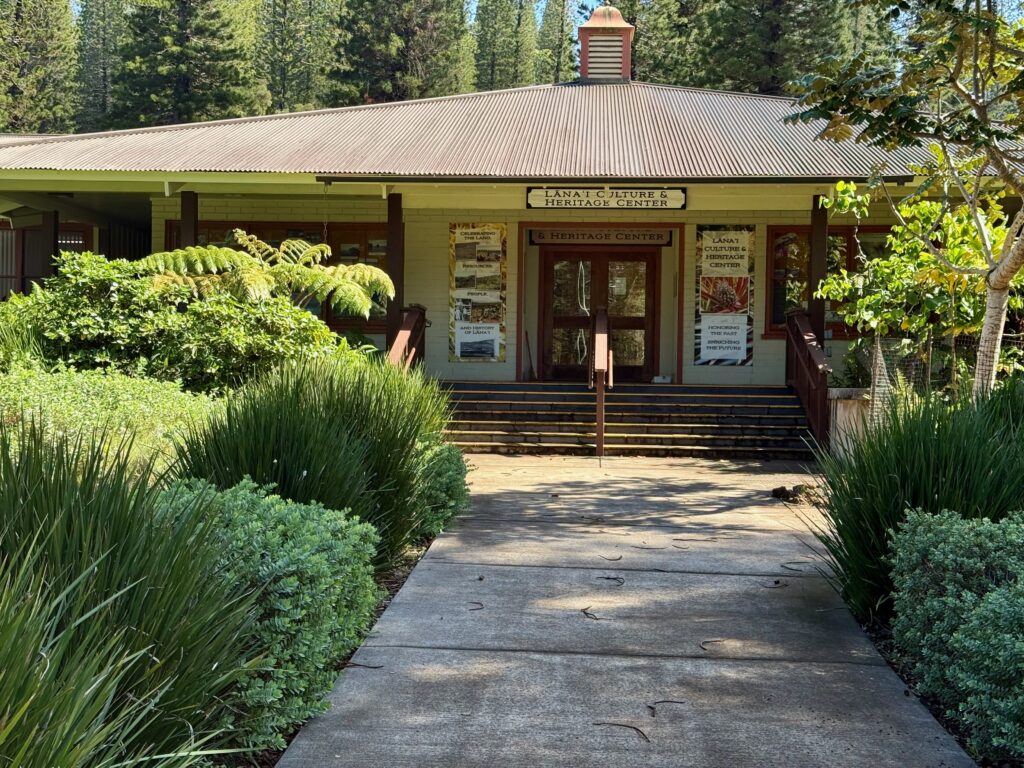
Little but mighty. Photo by Rina Nehdar
Children played on the small park playground, shaded by towering Cook Island and Norfolk pines. Grass carpets the park, and families lounged with their lunches around picnic tables.
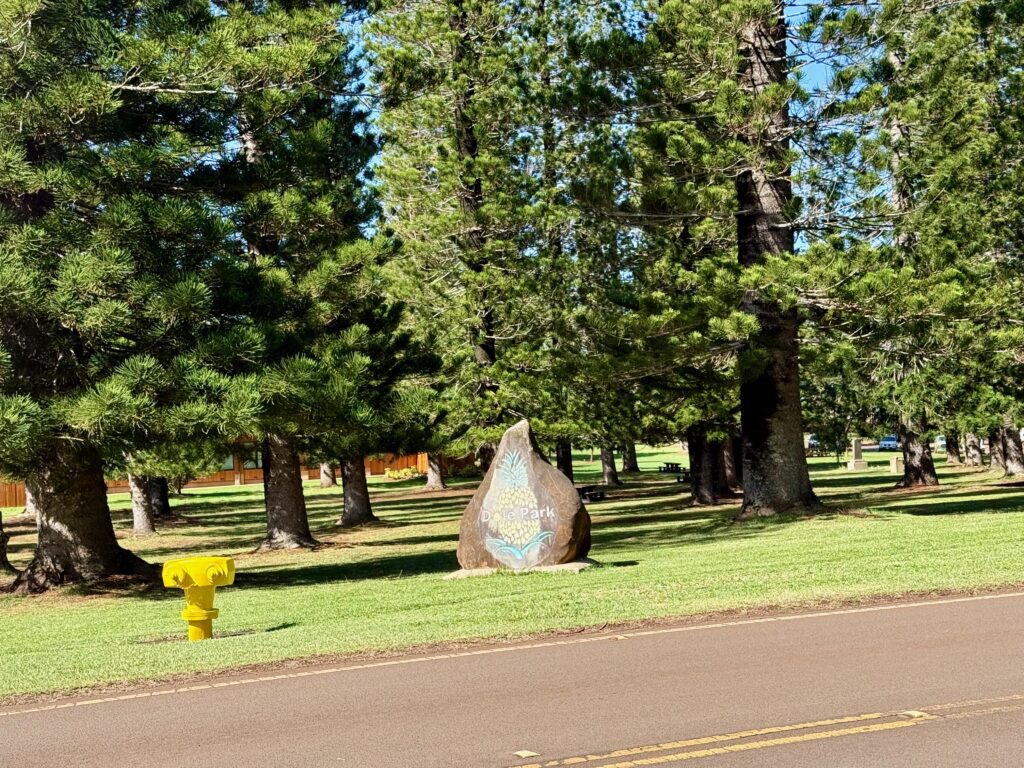
Central Park Lanai. Photo by Rina Nehdar
I popped into the bungalow-style shops and picked up gifts for Howard, my mom (who was watching our dog), and the boys. I peeked into the cultural center before we left just to get a little taste of island history beyond the billionaires who owned it.
More Snorkeling, Swim Party and Whale Tails
After our onboard lunch, we headed out to do snorkeling not far from Manele Harbor in Hulopo‘e Bay. The glassy water housed convict tang (manini), in prison stripes, bright yellow tang, and a kaleidoscope-hued reef.
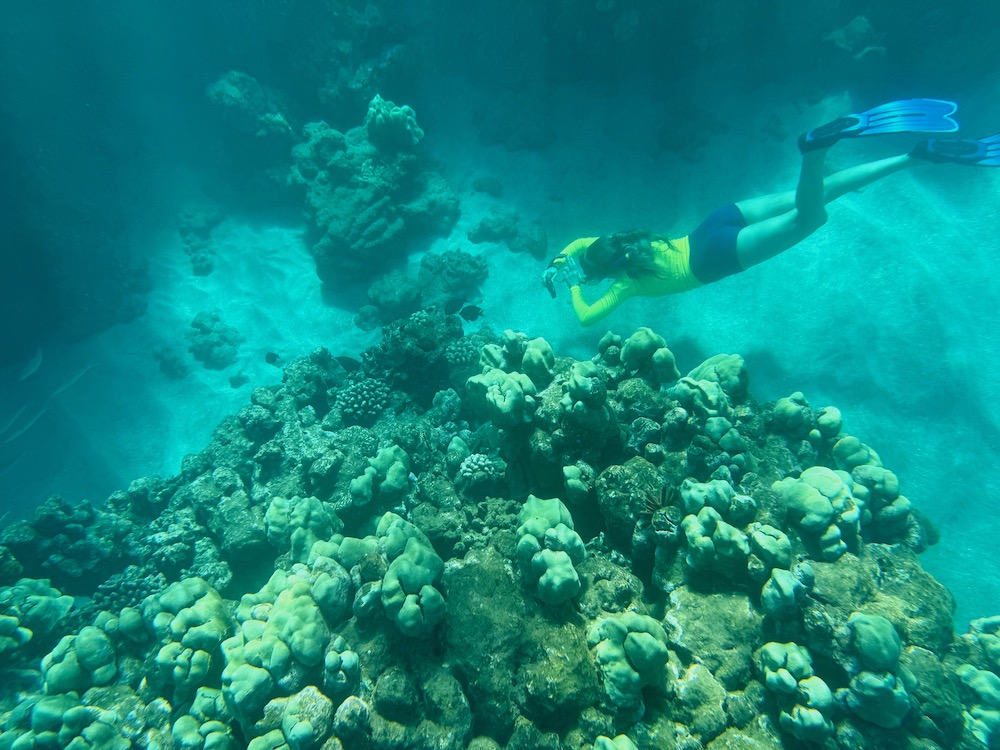
The expedition guides, like Shelby, took photos all week to include in our last night’s slideshow. Photo by Rina Nehdar
Afterward, we had a swim party off the boat. Most guests floated on noodles while hanging onto a trailing rope.
The crew had put out a platform from the second deck, and those who dared jumped off into the warm water. The boys took several turns jumping alone and with their phones. Howard and I also took the plunge.
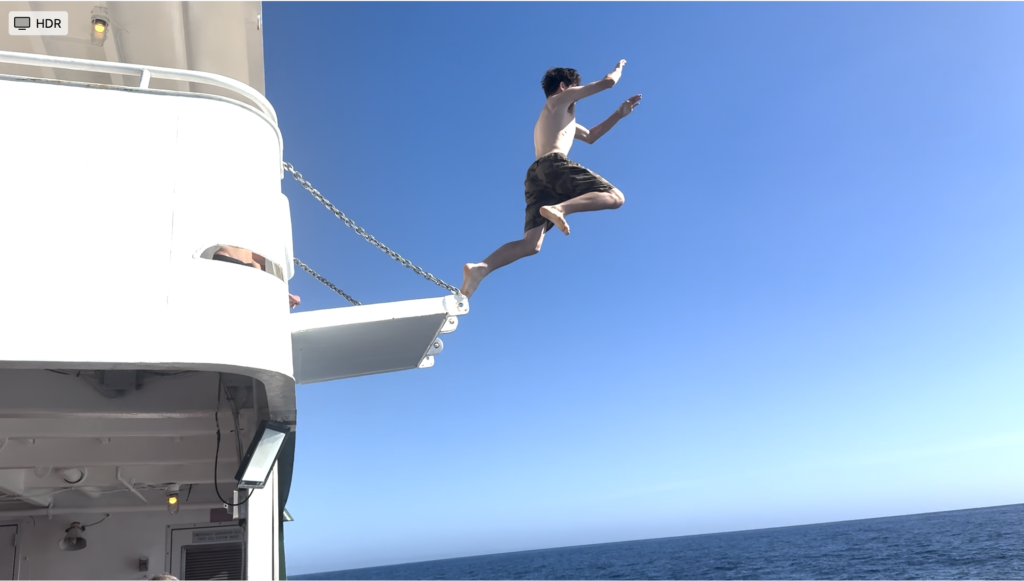
Knox living his best life. Photo by Rina Nehdar
As I hurtled into the open air, my lungs filled with the excitement of jumping into the unknown. We then took out the stand-up paddleboards.
The rest of the afternoon, the captain pursued humpback whales migrating through Hawaiʻi. Many decided to show off by jumping into the air, accompanied by our chorus of oooohs. Some said hi with tail slaps. We waved back.
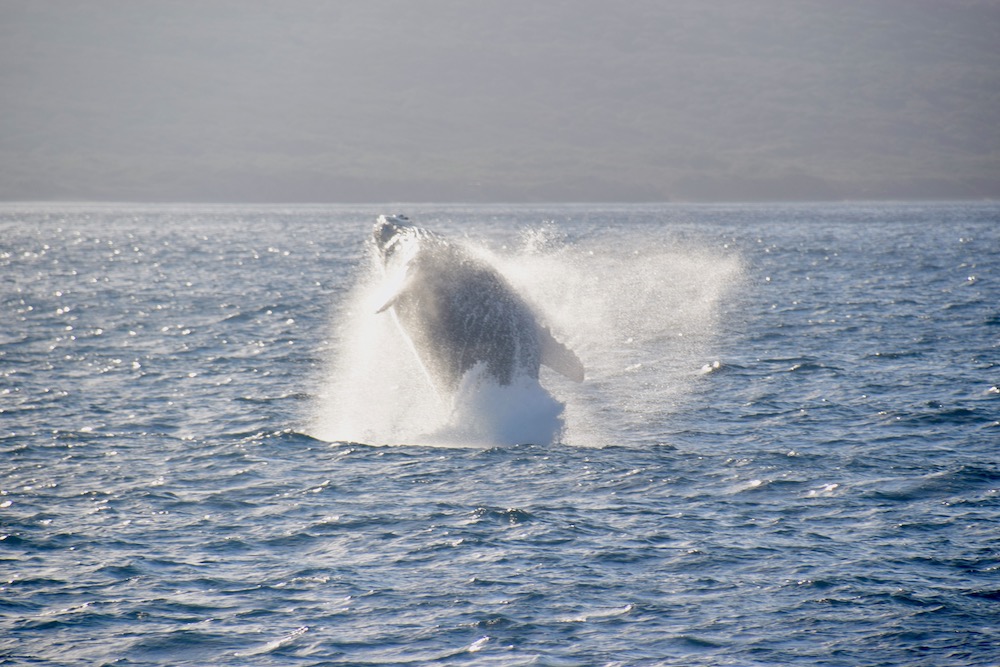
We had our own private sea life show! Photo by Rina Nehdar
Day 5: Kayaking West Maui, Monk Seals and a Turtle Cleaning Station
Monk Seals In West Maui
By 10:30 a.m., it already felt like a full day. We woke up, paired off after breakfast, and boarded kayaks (two guests opted for the skiff tour instead, with the hydro-audio amplifier to hear whale songs).
Knox came with me because Kaleb kept trying to bother him. Kaleb went with Howard.
We all paddled 3 miles from the ship to West Maui. Quiet settled over the water with only the splash of our paddles punctuating the calm sunny day. Turtles poked their bald green heads out of a blue ocean as we passed. Dai Mar, who at this point seemed to know something about everything, showed everyone how to surf the small waves with the kayaks, and Knox and I practiced gliding along the ripples.
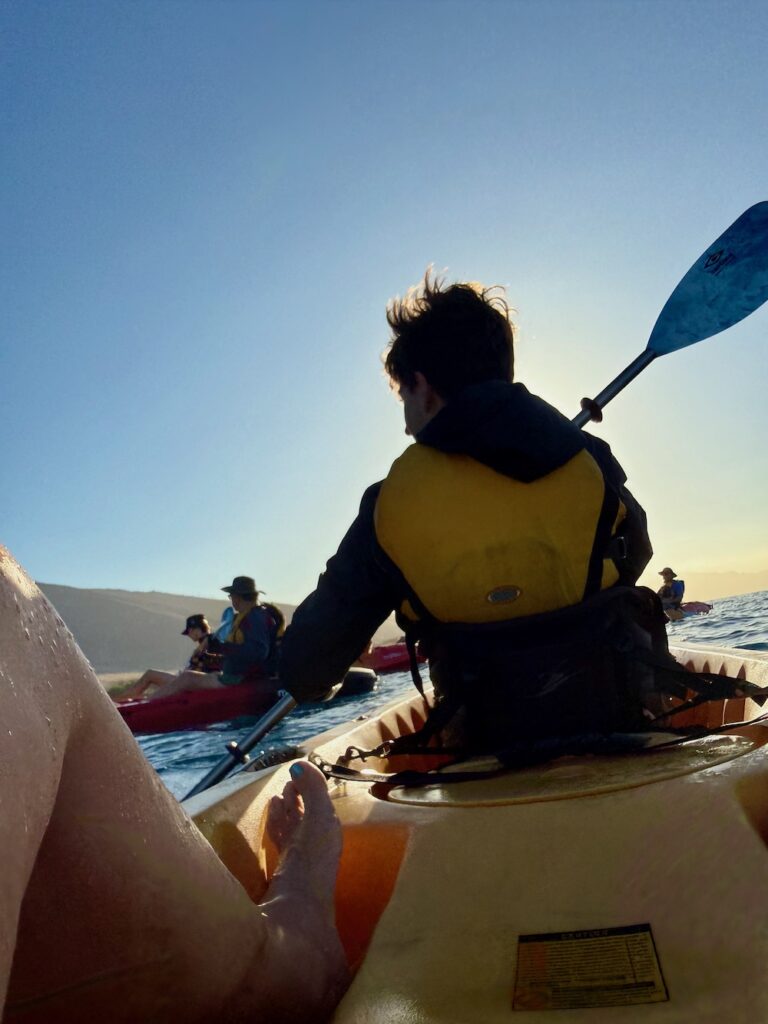
I let him do most of the work. Photo by Rina Nehdar
We paddled in a ragged line skirting about 200 feet from the shore, but for whatever reason, Howard and Kaleb broke off from the group and started making their way toward the open water. We could hear Kaleb yelling at Howard as he paddled them farther away from us. We weren’t sure where they were going, but we could hear Kaleb questioning the same thing 500 feet away. Knox and I had a good laugh.
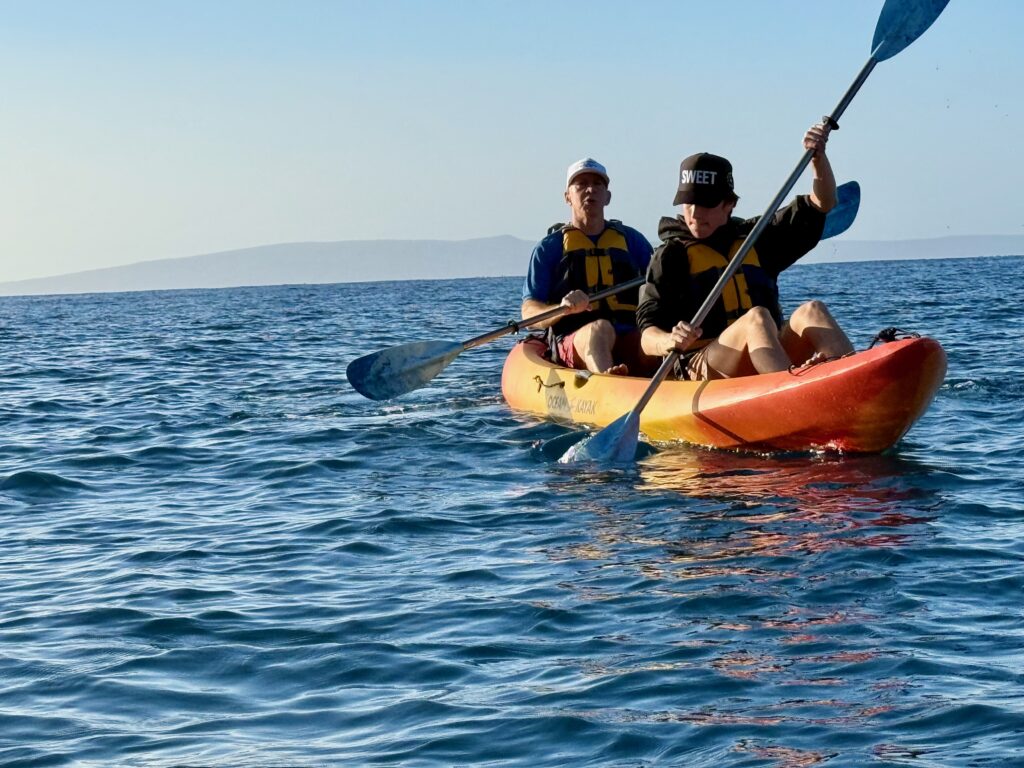
Before the split. Photo by Rina Nehdar
After their return, Dai Mar spotted two monk seals sunning themselves by a red-roofed building. He explained how incredibly lucky we were to see them because they’re an endangered species. There are only about 1,600 left in the world.
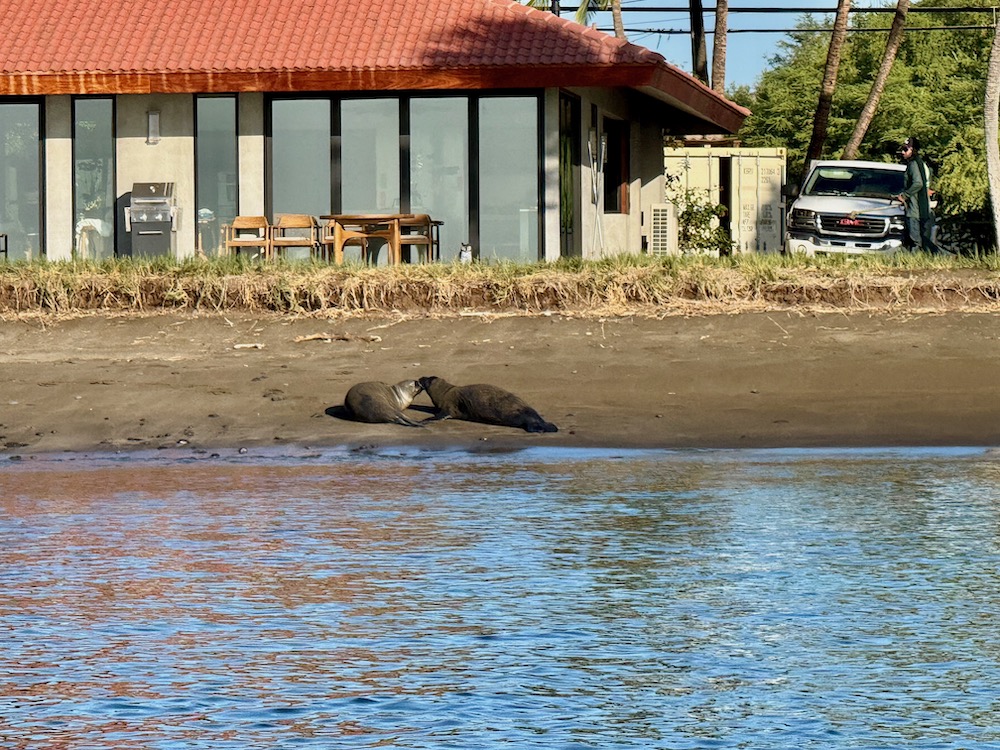
Getting some color. Photo by Rina Nehdar
Turtle Cleaning Station
After lunch, we slid into the water with our snorkels. Howard and I pointed our flippers in the direction of the area where we had kayaked earlier to see if we could reunite with the bobbing green turtles, but Kaleb caught up to us and told us we were heading in the wrong direction. He told us there was something called a “turtle cleaning station” where goldring surgeonfish nibbled on the green algal “fuzz,” loose skin, and parasites growing on the turtles’ shells, flippers, and faces. We followed him and marveled at about 10 turtles receiving their spa treatments.
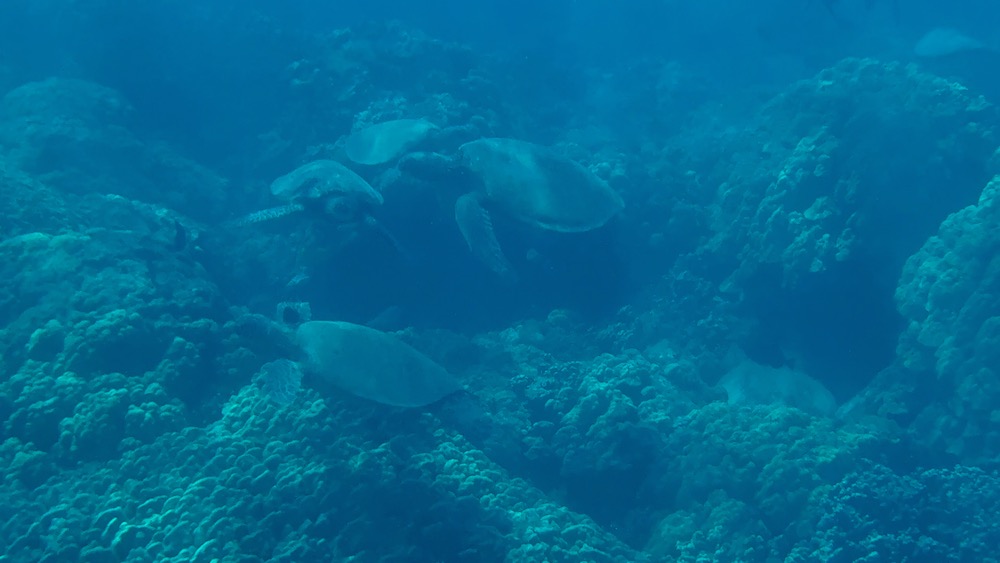
Turtle spa day. Photo by Rina Nehdar
A Surprise Guest
For our evening talk, Dai Mar reached out to his buddy Ed Lyman, a Natural Resource Specialist from the Hawaiʻian Islands Humpback Whale National Whale Sanctuary. Lyman is the premier expert on humpback whales, and he shared a few tidbits with us. I kept turning my head to look at the boys in the darkened lounge to see if they were listening, and each time my mommy heart beat with joy to see them fully invested.
“Flukes are like fingerprints for whales,” said Lyman as he put a whale-tail slide on the screen. “They can be identified by their pattern. People all over the world register them on happywhale.com so you could see where your whale has traveled and get updates on it.”
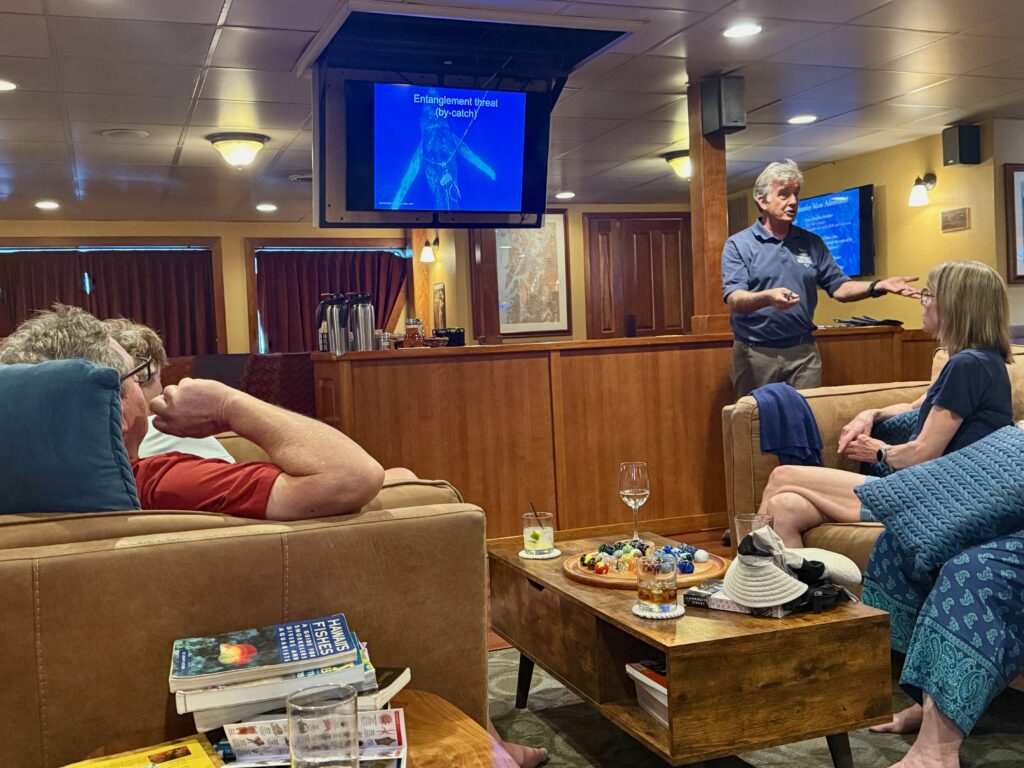
Ed Lyman presenting whale tales. Photo by Rina Nehdar
After he was done and the guests mingled with the crew, some with cocktails in hand, Knox came up to Lyman and said, “That was the best presentation, thank you.” Flutter, flutter.
That night, we took the Alenuihaha passage to the South Kona area on the western side of Hawaiʻi Island (the Big Island). We had been forewarned that it had a tendency to get choppy. Luckily, it was rough but not as rough as our imaginations had predicted.
Day 6: Snorkeling Kealakekua Bay and South Kona’s Lava Cliffs
The crew had to cancel our planned kayaking activity and night snorkel due to the rough ocean conditions. The part I was looking forward to, with a little trepidation, was the night snorkel. Everything is a little scarier in the dark.
Instead, we took a skiff tour of the ʻŌpihihale lava cliffs. The waves pounded against the thick black cliffs, and more than once I considered what it would be like if the surge carried the boat with it. Still, the light blue sky and the sapphire water lightened my heart, and seeing my boys sitting along the edge of the vessel made me grateful they were learning their lessons in such a beautiful classroom.
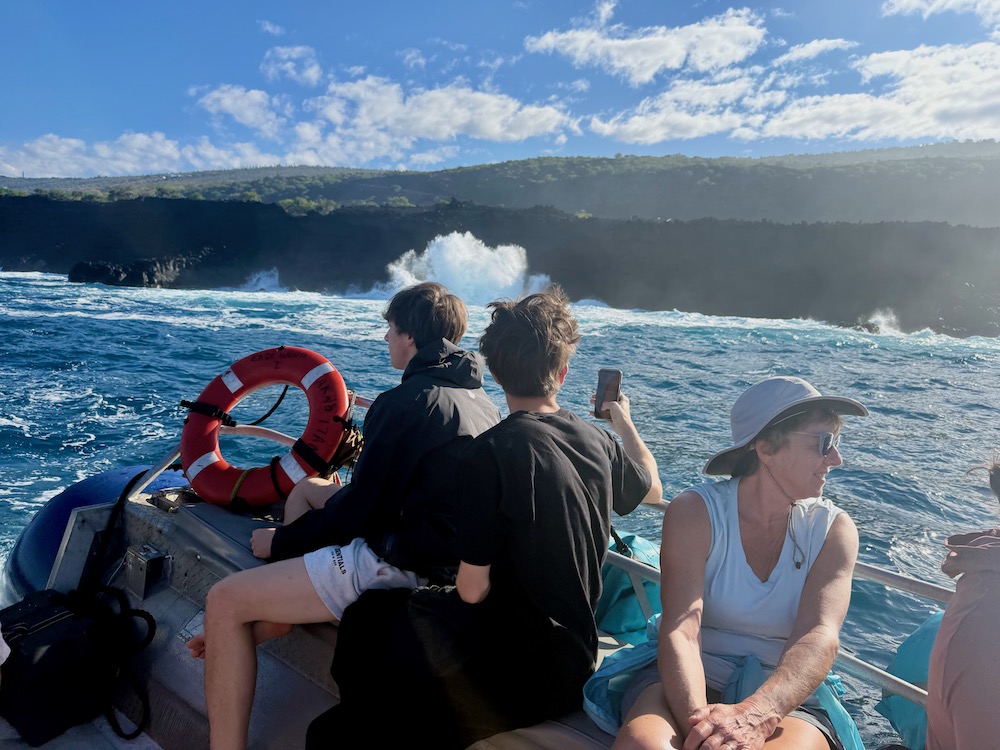
The immersive classroom. Photo by Rina Nehdar
We did an afternoon snorkel south of Kailua-Kona off the Big Island, in Kealakekua Bay State Historical Park—the place where Captain Cook was killed in 1779 after trying to take the local ruling chief hostage over a stolen ship’s boat. An obelisk-shaped monument, constructed in 1874, stands today in Kealakekua Bay near the spot where Cook died. The land on which the obelisk sits was deeded to the United Kingdom by Hawaiʻian Princess Miriam Likelike in 1877.
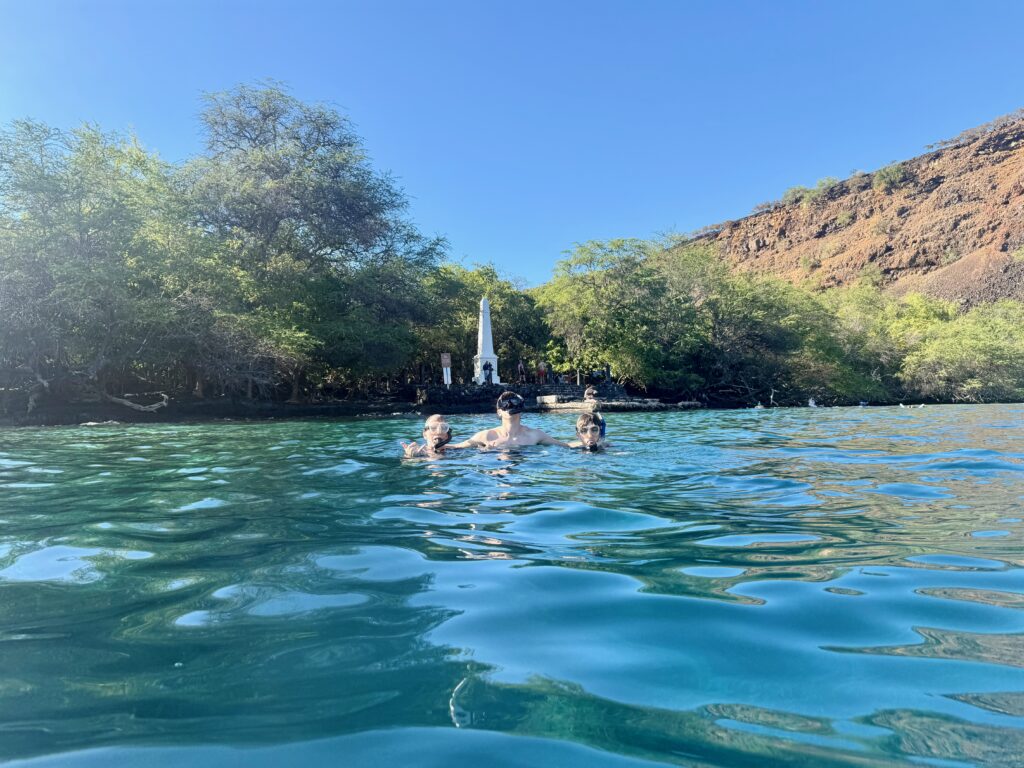
Swimming in history. Photo by Rina Nehdar
Besides the fantastical nature of the site, this was my favorite snorkel spot.
The water was the warmest of the trip. Towering sea cliffs shelter the bay from wind and open-ocean swells, and because it’s a protected Marine Life Conservation District, the reef is thriving. Yellow tang, butterflyfish, and triggerfish swarmed the shallow, rainbow-hued coral, while moray eels peeked out from its crevices. The boys saw a spinner dolphin that I tried to unsuccessfully find, flippers flapping, on my own. Of course, I spent my time filming the boys as they explored marine life underwater and threw peace signs.
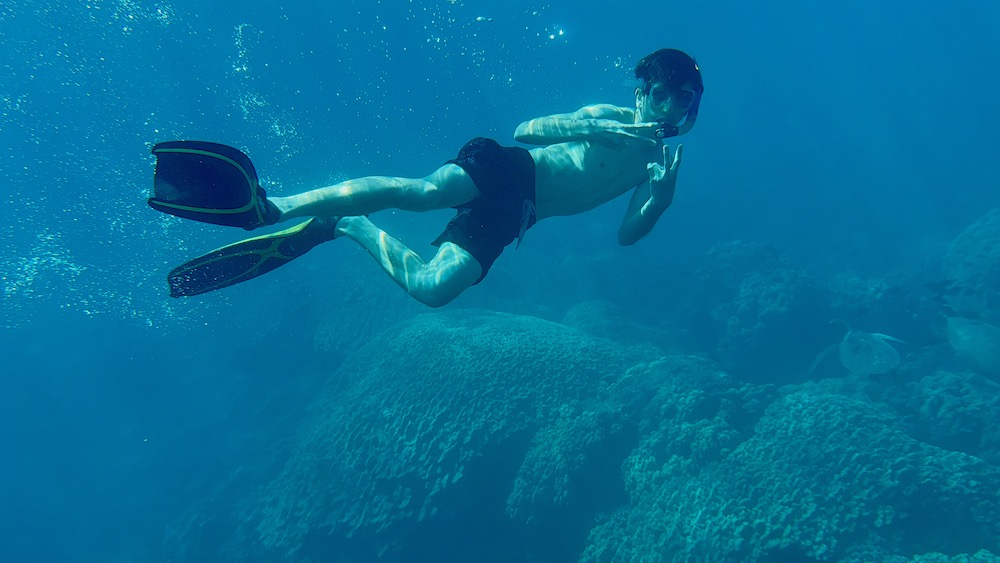
What up, bro? Photo by Rina Nehdar
Day 7: Kaloko-Honokōhau National Historical Park and Farewell Dinner
On our last full day, we broke off into two groups. The boys and Howard chose to do a lava tube hike that involved climbing underground with ropes. This sounded amazing to me but my little body sounded the alarm, and I chose to go with the other group on a walk along Kaloko-Honokōhau National Historical Park.
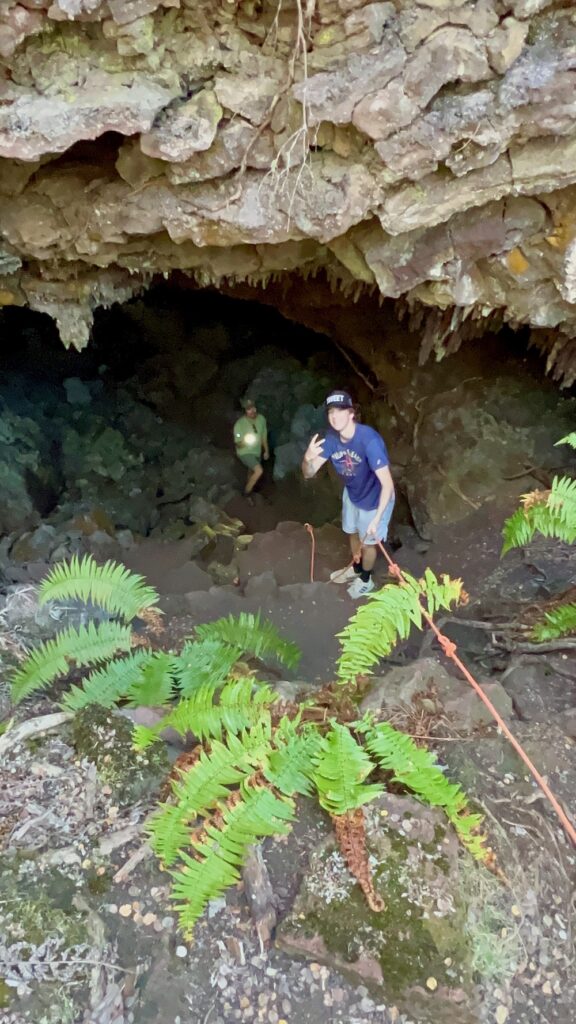
Not for me. Photo by Howard Nehdar
We docked our vessel at Honokōhau Small Boat Harbor, boats bobbing in slips from our passing swell, and walked to the southern shoreline of Kaloko-Honokōhau National Historical Park. Black lava rocks and sand lined the coast with palm trees swaying in the lazy wind to our right. The pointy tip of a replicated fish hut, made of logs and thatch, stood facing the ocean. Nearby, surrounded by the fluctuating tide, the Ai‘ōpio Fishtrap drew a few curious beachgoers who gazed into the water trapped inside the stone walls exposed by the lowering tide.
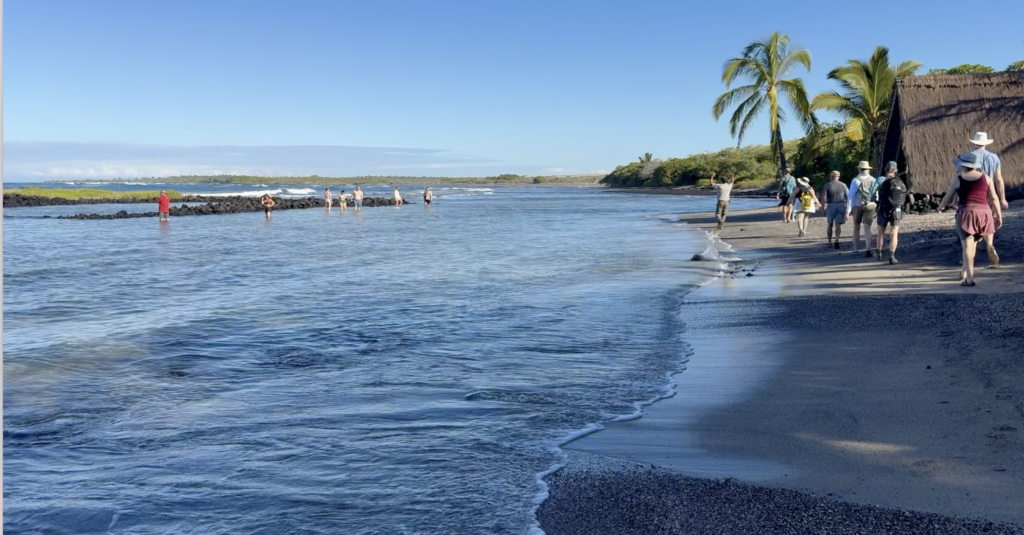
A serene escape. Photo by Rina Nehdar
“What are they looking at?” I asked a person standing by the hut and looking in that direction. “It’s a trapped monk seal,” the lady replied. She told us that the monk seal had gotten stuck in the fish trap when it came in to feed during high tide. The tide receded, and the rocks formed a corral above the waterline, temporarily trapping the monk seal. Monk seal sightings are so rare, she told us, that an organization is dedicated to protecting them from curious humans so the endangered mammals have the space they need to stay calm.
We continued skirting the blue water, taking photos of colorful seabirds perched on black rock, fuzzy palm trees in pretzel formations, and our UnCruise ship standing stalwart in the distance.
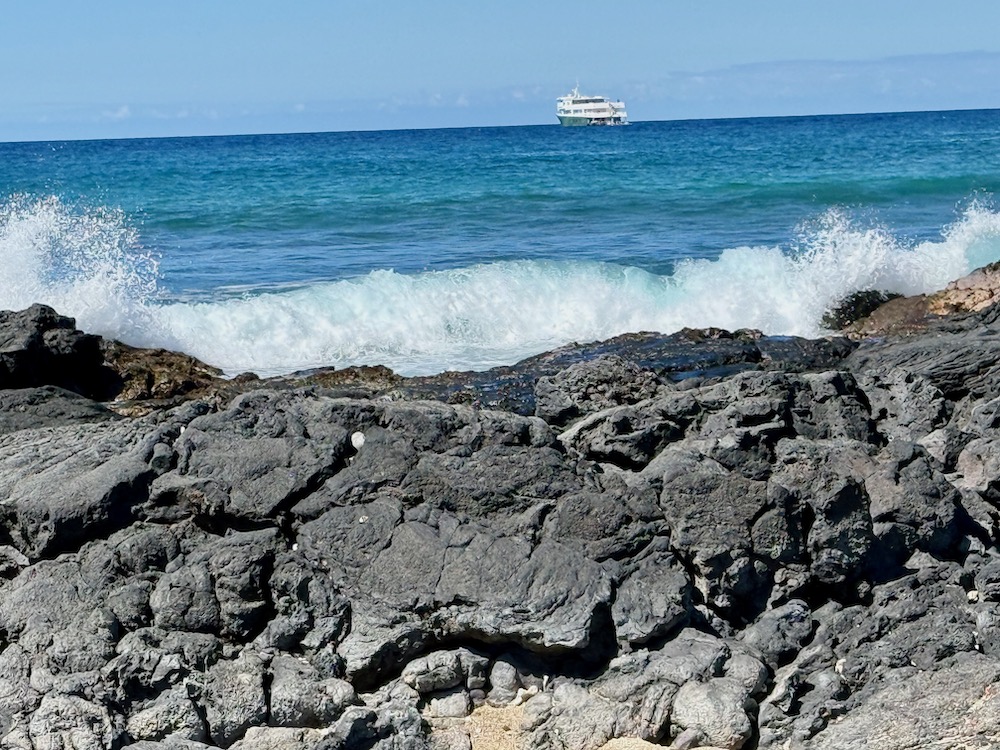
Keeping a watchful eye. Photo by Rina Nehdar
That night there was a big celebration. Our crew all came down for dinner and took turns bowing as we clapped our gratitude for making the week one of the best we’d ever had. Howard had recently celebrated a birthday so everyone sang to him, and he bowed his head in gratitude.
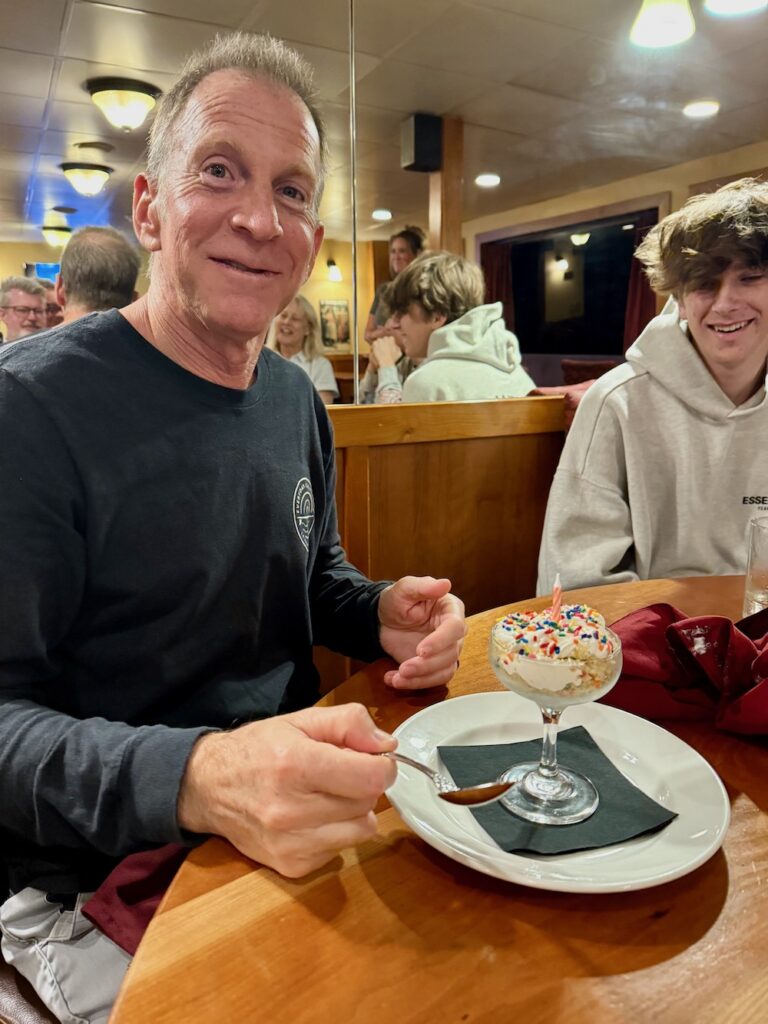
Special treat. Photo by Rina Nehdar
The crew had taken pictures all week, underwater, overwater, on the hikes, and bike rides. We sat in the darkened lounge and instead of learning something new we’d experience the next day, we witnessed the magic we had discovered all week. Photo after photo, we laughed. We glanced at each other, smiling at our images, immortalized in special memories.
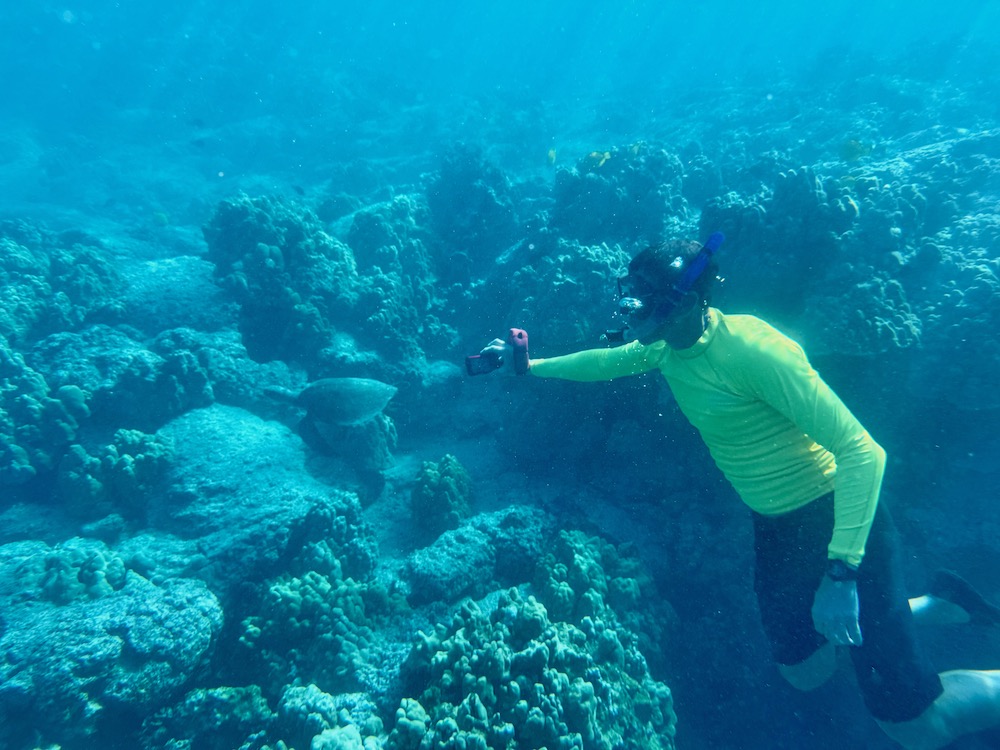
Dai Mar adding to his collection. Photo by Rina Nehdar
We came to experience the magic of the islands, but we discovered their memories as we formed our own. It took our breath away.
Is an UnCruise Hawaii Cruise Good for Kids and Teens?
Yes, for active families. It’s best for kids and teens who swim confidently and like hiking, kayaking and being outdoors all day. It’s not a fit for kids who want a pool deck, water slides or a kids’ club. Our 15- and 17-year-olds loved it. UnCruise also runs an Alaska Family Cruise.
My boys loved climbing the cliffs on our waterfall hike and splashing into the water below. They loved exploring caves and challenging themselves with adventures. The great thing about these sailings is that they have activities for all mobility levels.
UnCruise vs. a Big-Ship Hawaii Cruise
| UnCruise Safari Explorer | NCL Pride of America | |
|---|---|---|
| Guests | Up to 36 | 2,186 |
| Length | 7 nights | 7 days, no sea days |
| Islands | Molokai, Lanai, Maui, Big Island | Oahu, Maui, Big Island (Hilo, Kona), Kauai |
| Excursions | Included, guided daily | Extra cost |
| Best for | Small groups, wildlife and Hawaiian culture | Ship amenities and classic Hawaii ports |
Pride of America details: Cruise Critic
Prefer a big ship that sails from home? See why this cruise from Los Angeles is perfect for teens.
IF YOU ENJOYED THIS ARTICLE, PLEASE CONSIDER PINNING OR SHARING IT
UnCruise Hawaii FAQs
What is an UnCruise Hawaii cruise like?
It’s a seven-night small-ship expedition cruise with up to 36 guests, built around daily guided adventures and Hawaiian culture. Days include hiking, snorkeling, kayaking, paddleboarding and skiff tours, with evening talks from the crew and local experts.
Is an UnCruise Hawaii cruise good for kids?
Yes, for active kids 6 and older and teens who swim confidently and enjoy the outdoors. There’s no pool or kids’ club, so it’s best for families who want adventure over ship amenities.
Which islands does UnCruise visit in Hawaii?
The Hawaiian Seascapes itinerary visits Molokai, Lanai, Maui and Hawaiʻi Island (the Big Island). It runs in either direction, and stops can change with the weather and ocean conditions.
How much does an UnCruise Hawaii cruise cost?
About $8,700 per person. Meals and guided excursions are included. UnCruise lists $500 off for kids under 18.
Is there a minimum age for UnCruise Hawaii?
Yes, the minimum age is 6. The trip is best for kids who swim well and can handle multi-mile hikes.
Can you snorkel Kealakekua Bay on an UnCruise?
Yes. Our sailing snorkeled Kealakekua Bay State Historical Park, near the Captain Cook Monument, and it was our favorite snorkel of the trip.
When can you see whales on a Hawaii cruise?
Humpback whales are in Hawaii from November through April, with peak season from January through March, according to NOAA. We saw breaches and tail slaps on several days of our sailing.
Is the ʻAlenuihāhā Channel crossing rough?
It can be. The channel between Maui and the Big Island is known for chop. Our overnight crossing was rough but manageable, so pack motion-sickness remedies like ginger.
What should kids pack for an UnCruise Hawaii cruise?
Sturdy hiking shoes that can get wet, water shoes, reef-safe sunscreen, a rash guard, a light rain jacket and a waterproof phone case. UnCruise provides snorkel gear.
UnCruise or Norwegian’s Pride of America: which is better for families?
Choose UnCruise for small groups, included adventures and lesser-visited islands like Molokai and Lanai. Choose Pride of America for big-ship amenities and stops on Oahu and Kauai.
[/et_pb_text][/et_pb_column] [/et_pb_row] [/et_pb_section]
Rina Baraz Nehdar is a multi-award-winning journalist and photographer. Rina's background is in television and radio news. She is editor and founder of www.LAFamilyTravel.com which helps Los Angeles area families plan their best trips with kids. Rina's writing focuses on family adventure travel, eco-travel, and luxury travel. Her work has appeared in Travel + Leisure, Parents, L.A. Parent, Global Traveler Magazine and more. As a family travel expert, she has been featured in The New York Times, Forbes, Spectrum News and podcasts. She is an active member of SATW and NATJA.